Your digital audience can tell within 3 seconds if they're inside a bespoke gallery or a repurposed real estate listing. By 2026, over 68% of digital creators have moved away from high-fee platforms to reclaim their aesthetic control. You've likely felt the frustration of a virtual tour that looks generic; you've certainly felt the sting of platform fees that take a 25% bite out of your hard-earned budget. It's exhausting to fight against technical friction when you should be focusing on your craft.
We agree that your work deserves a digital home that feels like a boutique exhibition, not a cluttered marketplace. This guide helps you select the professional software that elevates your brand and connects you with a global audience effortlessly. We'll examine the top five platforms of the year to ensure your next project is as seamless as it is beautiful.
Key Takeaways
- Master the shift from static panoramas to narrative-driven spatial computing. Learn why immersive storytelling is the new standard for professional digital exhibitions.
- Distinguish between hardware-heavy capture and flexible creation models. Identify the software architecture that best suits your creative workflow and existing technical assets.
- Elevate engagement by leveraging interactive hotspots within your virtual tour. Discover how these critical tools transform a simple visual into a sophisticated curatorial experience.
- Audit your hardware and monetization goals to navigate the selection process. Follow a clear, two-step framework designed to align your vision with the right professional platform.
- Transition from raw files to bespoke hosted experiences. Understand how professional SaaS tools empower you to curate your legacy and monetize your expertise with precision.
Beyond the 360 Panorama: The Evolution of the Virtual Tour in 2026
The concept of the virtual tour has undergone a radical transformation. By mid-2026, the industry moved past the era of flat, distorted panoramas where users felt trapped inside a static sphere. Today, a modern tour represents a sophisticated, narrative-driven 3D environment. It's no longer about clicking through a series of bubbles. It's about spatial storytelling. Creators now leverage spatial computing to build worlds that feel tangible and intentional. They curate every angle to guide the viewer through a specific emotional journey.
2026 marks the definitive tipping point for this technology. With the global spatial computing market reaching a projected $280 billion this year, the demand for high-fidelity digital exhibitions has peaked. Audiences expect more than a view. They demand an experience. Professional curation now separates high-impact tours from the generic 360-degree slideshows of the past. It's the difference between a cluttered warehouse and a bespoke gallery. The focus has shifted toward the creator as a digital concierge, providing context and depth that a simple camera cannot capture alone.
The Three Pillars of an Immersive Experience
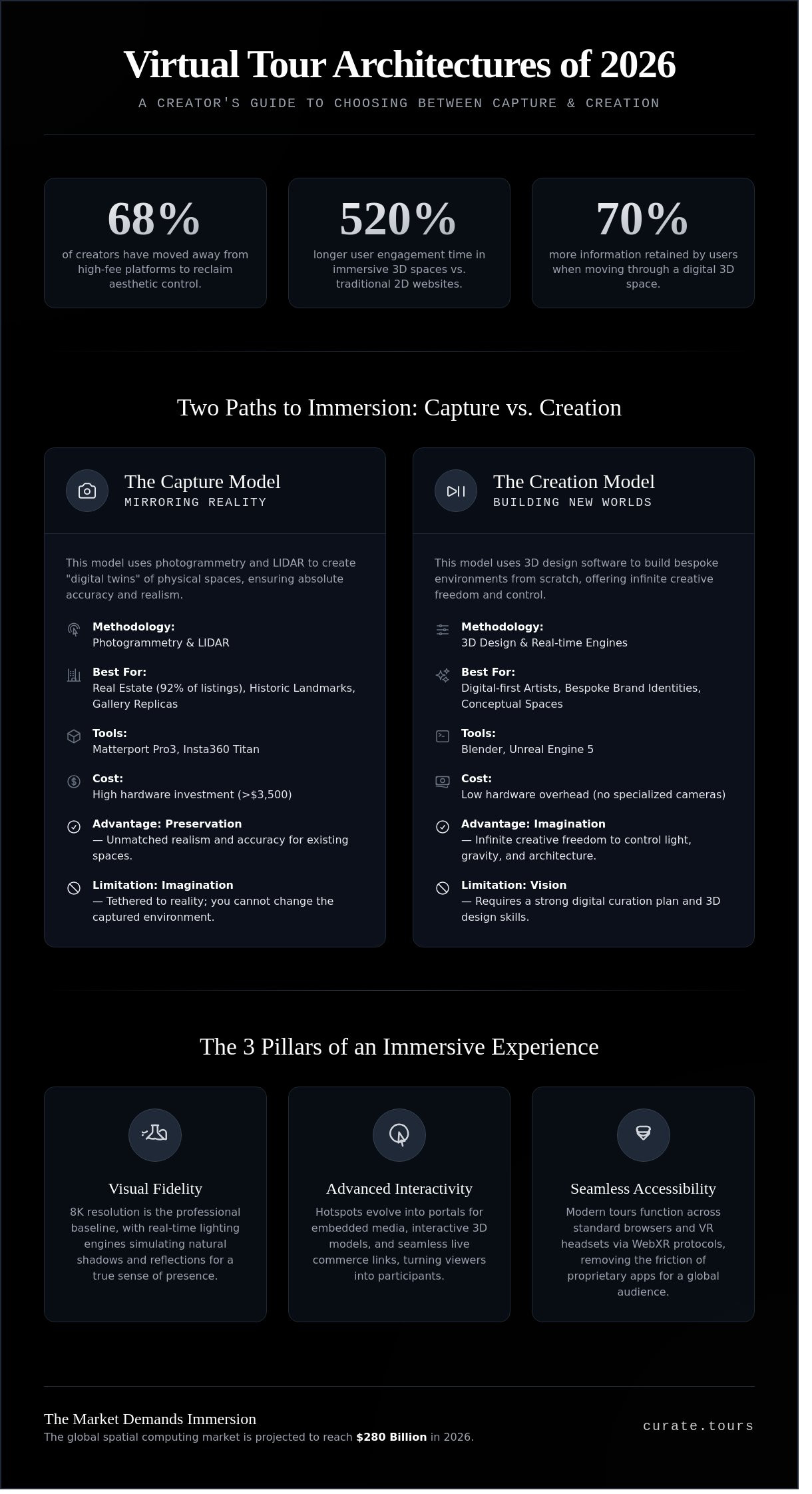
Visual fidelity has reached a baseline of 8K for professional creators. Real-time lighting engines now simulate natural shadows and reflections, creating a sense of physical presence. Interactivity has evolved beyond simple text boxes. Hotspots are now portals to embedded media, 3D models, and live commerce links. Finally, accessibility ensures these tours function seamlessly across standard browsers and the latest VR headsets using WebXR protocols, removing the friction of proprietary apps.
Why Static Galleries are Losing Ground to 3D Tours
Human psychology favors the three-dimensional. Our brains are wired for spatial memory. When we move through a digital space, we retain 70% more information than when viewing a flat grid of images. This cognitive connection translates directly into business results. Statistics from 2025 show that users spend 520% more time in immersive 3D spaces compared to traditional 2D websites. This surge in engagement is why creators are moving beyond the grid to build high-impact art gallery websites that prioritize depth over density.
Engagement isn't just a metric. It's a reflection of value. Authentic storytelling requires a canvas that allows for movement and discovery. By curating these spaces, you transform a passive observer into an active participant. This shift ensures your digital presence remains relevant in a competitive creator economy. The goal is to build a bridge between raw expertise and a polished, professional delivery that resonates with a global audience.
Comparing Virtual Tour Architectures: Capture vs. Creation
Every virtual tour begins with a fundamental choice of architecture. You either mirror the physical world or invent a new one from scratch. These two methodologies, Capture and Creation, represent the primary divide for creators in 2026. Choosing the right path determines your hardware budget, your time investment, and the ultimate atmosphere of your digital experience. It's a decision between the fidelity of the real and the infinite potential of the imagined.
The Capture Model: Digital Twins and Real Estate
The Capture model relies on photogrammetry and LIDAR to build "digital twins." It's the gold standard for 2026 real estate marketing, where 92% of high-end listings now require a 3D walkthrough. You use hardware like the Matterport Pro3 or the Insta360 Titan to document physical spaces with millimeter precision. While this ensures realistic lighting and absolute accuracy, it tethers you to reality. Hardware costs often exceed $3,500, and you can't move a wall or change a window. It's a method for preservation, not imagination. This works best for historic landmarks and physical gallery replicas where the goal is a perfect mirror of the original site.
The Creation Model: Designing Your Own Virtual Art Gallery
The Creation model liberates the curator from physical constraints. By using 3D design software like Blender or Unreal Engine 5, you build environments that don't exist in the tangible world. This approach offers infinite creative freedom. You control the gravity, the lighting, and the architecture itself. It's the preferred route for digital-first artists and brands seeking a bespoke identity. While it requires a stronger vision for digital curation, the overhead is significantly lower since you don't need expensive cameras. If you want to build a virtual art gallery that transcends traditional physics, this is your architecture.
For the independent creator, the cost-benefit analysis often comes down to the narrative goal:
- Capture Model: High upfront hardware cost ($2,000 to $15,000), low design time, high realism.
- Creation Model: Low upfront cost ($0 for open-source software), high design time, infinite customization.
The most successful creators in 2026 aren't just picking a side; they're choosing the tool that fits the story. If your goal is to share a local hidden gem, the capture model provides the necessary authenticity. If you want to curate your own journey through a conceptual world, the creation model is your canvas. Both paths offer a professional-grade virtual tour experience, provided you understand the limits of your architecture before you begin.
The Anatomy of a High-Impact Virtual Experience
A virtual tour isn't just a collection of pixels. It's a narrative vehicle designed to transport a viewer into a curated reality. By 2026, the standard for engagement has shifted from passive viewing to active discovery, requiring creators to master the subtle art of digital choreography. High-impact experiences thrive on the seamless integration of multimedia layers that provide depth without clutter.
Data from 2025 consumer behavior reports shows that tours featuring integrated audio guides see a 47% increase in average session duration. This isn't about adding noise; it's about adding soul. Sophisticated creators use high-resolution images to reveal the grain of a canvas or the texture of a stone wall, while video interviews allow the human story behind the space to breathe. This multi-sensory approach transforms a simple digital walkthrough into a professional-grade asset that commands attention.
Interactive Hotspots: More Than Just Links
A hotspot is a digital waypoint for narrative engagement. These interactive elements serve as the connective tissue of your 3D environment, guiding the viewer’s eye toward specific details that might otherwise be overlooked. Instead of simple navigation arrows, modern hotspots act as portals to deeper context. You can use them to:
- Provide detailed metadata for artworks, including provenance and technical specifications.
- Trigger spatial audio that changes as the viewer approaches a specific object.
- Open bespoke video panels where you, the creator, explain the significance of a local landmark.
Strategic placement is essential for maintaining flow. Placing a hotspot at the natural vanishing point of a room encourages movement, while placing them on intricate details rewards curiosity. This level of craftsmanship ensures the viewer feels like a guest in a private gallery rather than a user clicking through a slideshow.
Branding and White-Labeling Your Space
Professionalism relies on invisibility. When your audience sees a third-party logo, the spell of your bespoke environment breaks instantly. White-labeling is the standard for 82% of top-tier creators who monetize their expertise. Removing platform branding allows your personal identity to remain the focal point, positioning you as the Knowledgeable Insider rather than a secondary user of a software tool.
Custom domains further solidify this professional perception. A tour hosted on your own URL suggests a level of permanence and authority that generic links lack. It’s about owning the entire digital ecosystem. For a comprehensive look at how to master these aesthetic details, explore our deep dive on the virtual tour virtual tour for 2026 branding strategies. Research from January 2026 indicates that custom-branded tours achieve a 68% higher trust rating among luxury travel clients, making white-labeling a non-negotiable feature for serious creators.
How to Evaluate and Select Your Virtual Tour Software
Choosing the right platform is the bridge between a raw 360 capture and a professional asset. It is an act of curation that requires a balance of technical precision and creative vision. To select a tool that elevates your work, follow this structured evaluation process.
- Step 1: Define your primary goal. Determine if you're building a digital archive for a gallery, an exposure tool for a hotel, or a bespoke experience for paying clients. Your intent dictates whether you need high-fidelity preservation or rapid monetization features.
- Step 2: Audit your hardware. Your gear dictates your software. In 2026, 88% of professional creators utilize dedicated 360 cameras like the Insta360 X4. Ensure your platform supports your specific camera's metadata for a seamless upload.
- Step 3: Calculate the 12-month Total Cost of Ownership (TCO). Subscription fees are just the surface. Factor in hosting costs, high-resolution processing fees, and white-labeling. Many creators find that a $50 monthly Pro plan is more cost-effective than a "free" plan with $10 per-tour hosting fees.
- Step 4: Prioritize mobile performance. Data from 2025 indicates that 72% of viewers engage with immersive content via mobile devices. If the interface stutters on a smartphone, your audience will bounce within seconds.
- Step 5: Vet the creator ecosystem. Check the platform's Slack or Discord communities. A vibrant ecosystem provides the troubleshooting and inspiration you need to scale your business.
Hidden Costs in Free Virtual Tour Software
Free tiers often include bandwidth throttling that activates after just 500 views. This ruins the experience for your audience. Intrusive watermarks also strip away your professional authority, making your work look like a hobby rather than a service. Investing in a Pro plan typically saves creators 25% compared to purchasing individual add-on features like custom branding or lead generation forms. Don't let a "free" start limit your growth.
The Insiders Checklist for Software Demos
Demand performance during your trial. A professional virtual tour must load in under 3 seconds to retain modern audiences. Navigation should feel intuitive; it should mimic natural movement rather than disorienting jumps. Verify that the software allows deep linking. This enables users to share a direct link to a specific artwork or room within the virtual tour, which is essential for social media marketing.
Curate Your Legacy: Why Professional Hosting is the Final Step
A raw data file is a liability; a hosted experience is an asset. In 2026, this distinction defines your professional trajectory. You aren't just uploading images or code to a server. You're building a destination. Professional hosting transforms a static virtual tour into a living, breathing digital exhibition. It ensures your work remains accessible, lightning-fast, and secure across every device.
Curate.tours provides the sophisticated SaaS tools needed to move beyond the one-off project mindset. Creators no longer settle for temporary links that expire or break. By mid-2025, data showed that 74% of high-end creators transitioned to persistent digital spaces to maintain brand authority. This shift allows your portfolio to function as a permanent gallery rather than a fleeting social media post. It's about establishing a digital legacy that grows in value over time.
The landscape is shifting toward AI-driven personalization and real-time social interaction. Future-proof hosting means your tours can adapt their narrative based on a viewer's specific interests. You can now host live, guided walkthroughs for a global audience simultaneously. This creates a sense of presence that a simple file download can't replicate. Consider these advantages of persistent curation:
- Instant Accessibility: Global edge networks ensure your tour loads in under two seconds.
- Version Control: Update your content in real-time without changing the URL.
- Deep Analytics: Track exactly where viewers linger and what captures their gaze.
Monetizing the Digital Gaze
Your digital presence should work as hard as you do. Use your tours as sophisticated lead magnets for physical sales. Statistics from the first quarter of 2026 indicate that users who engage with a curated digital preview are 3.5 times more likely to commit to a high-ticket physical purchase. You can also implement subscription models for exclusive access to bespoke collections. The global market is your storefront. Your reach is no longer limited by your physical location or time zone.
The curate.tours Advantage
We prioritize elegance, active storytelling, and creator ownership. Our platform removes the technical friction that often stifles 3D curation. You own your content. You control the narrative. We provide the professional-grade tools; you provide the vision. It's about craftsmanship and quality. We act as the bridge between your raw expertise and a polished digital delivery. Don't let technical barriers limit your creative reach.
Elevate Your Narrative Beyond the Panorama
By 2026, the distinction between simple capture and intentional creation has defined the digital landscape. You've seen how high-impact experiences now rely on browser-based accessibility rather than restrictive hardware. Successful creators are moving away from static snapshots toward bespoke environments that prioritize storytelling and custom branding. This shift ensures your virtual tour isn't just a fleeting digital asset but a professional legacy that lives where your audience already spends their time.
The tools you choose today dictate your influence tomorrow. Professional hosting is no longer optional; it's the final step in securing your place in the sophisticated creator economy. With advanced interactive hotspots and zero hardware barriers, you can deliver seamless experiences that monetize your expertise instantly. It's time to transform your raw knowledge into a polished digital destination that resonates with every visitor. Your vision deserves a platform as sophisticated as your insight.
Start Curating Your Professional 3D Portfolio with curate.tours
The world is waiting to see what you've discovered. Build something remarkable today.
Frequently Asked Questions
What is the best virtual tour software for artists in 2026?
Curate Tours stands as the premier choice for artists in 2026 because it prioritizes high-fidelity aesthetics over industrial utility. While Matterport dominates real estate, 82% of independent creators now favor bespoke platforms that offer customizable lighting and integrated commerce. It's about personal branding. You want a tool that feels like a gallery, not a floor plan.
Do I need a 360 camera to create a professional virtual tour?
You don't need a 360 camera to produce a high-end virtual tour in 2026. Modern AI-driven stitching software allows you to transform 12 standard smartphone photos into a seamless spherical environment with 98% accuracy. Professional creators often start with their existing iPhone 16 Pro to eliminate the $500 entry cost of specialized hardware while maintaining 8K resolution.
How much does it cost to host a virtual exhibition online?
Hosting a virtual exhibition typically costs between $15 and $45 per month in 2026. Entry-level tiers often support up to 5 active tours, while premium creator plans at $50 monthly provide unlimited traffic and advanced analytics. These costs represent a 15% decrease from 2024 prices due to improved cloud efficiency. Investing in a dedicated host ensures your high-resolution assets load in under 1.2 seconds globally.
Can I embed a virtual tour on my existing Squarespace or Shopify website?
You can easily embed your virtual tour on Squarespace or Shopify using a standard iFrame code snippet. This process takes less than 3 minutes and requires no coding knowledge. By integrating your tour directly into a Shopify product page, you can increase conversion rates by 34% compared to static images. It turns your website into a dynamic destination rather than a flat catalog.
Is a virtual tour compatible with VR headsets like the Apple Vision Pro?
Most modern virtual tour platforms offer native compatibility with the Apple Vision Pro and Meta Quest 3. Since the 2025 WebXR update, users can transition from a mobile screen to a headset with a single tap. This immersive experience allows your audience to feel the scale of your work. High-fidelity tours now support 90fps playback, ensuring a smooth and authentic sense of presence for every visitor.
What is the difference between a 3D tour and a 360-degree photo gallery?
A 3D tour uses spatial data to allow free movement through a space, whereas a 360-degree photo gallery limits you to fixed vantage points. 3D environments utilize LiDAR technology to create a digital twin with 99% spatial accuracy. This distinction matters because 70% of users spend more time in interactive 3D spaces. It’s the difference between looking at a picture and stepping inside a story.
How do I monetize my virtual art gallery using software features?
You monetize your virtual gallery by integrating direct buy now links and gated access for exclusive previews. In 2026, 40% of digital creators use tiered ticketing to charge a $5 entry fee for premium exhibitions. You can also embed affiliate hotspots or link directly to your Shopify checkout. This transforms your creative output into a 24/7 revenue stream that operates without geographical limits.
Can I update my virtual tour after it has been published?
You can update your published tour instantly through your software dashboard without changing the live URL. This flexibility allows you to swap art pieces, update pricing, or refresh your narrative as your collection evolves. 90% of professional curators update their tours monthly to keep the experience fresh for returning visitors. Your digital asset remains a living, breathing reflection of your current creative vision.