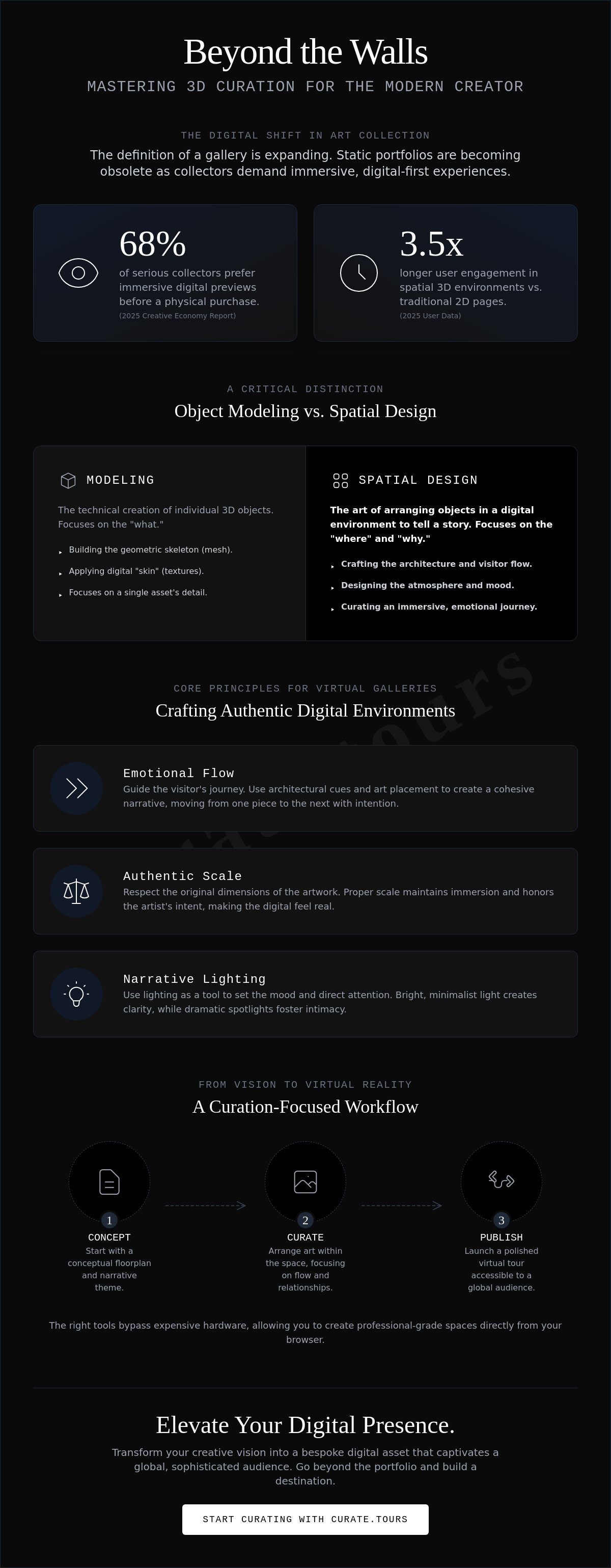
In 2026, the physical walls of a gallery are no longer the boundary of an artist's influence; they're the limitation. You've likely felt the frustration of wrestling with technical jargon or feared that digital spaces might look "cheap" compared to a physical room. It's a valid concern for creators who prioritize authenticity but lack the time to master complex software. According to a 2025 Creative Economy report, 68% of serious collectors now prefer engaging with immersive digital previews before committing to a physical purchase. Mastering 3d design doesn't have to be a technical chore.
We'll show you how to transform your creative vision into a bespoke, professional environment that captivates a global audience. You'll learn to curate a seamless virtual portfolio that reflects your brand with the precision of a high-end editor. This guide provides the roadmap to host your exhibitions online and reach every corner of the globe. We'll explore the essential tools and mindset needed to bridge the gap between raw expertise and polished digital delivery.
Key Takeaways
- Discover the essential distinction between object modeling and spatial 3d design to build truly immersive digital environments.
- Master the principles of emotional flow and scale to ensure your virtual gallery feels authentic and resonant for every visitor.
- Transition from a conceptual floorplan to a polished virtual tour by focusing on the art of curation rather than technical building.
- Identify the right tools to bypass expensive hardware, allowing you to create professional-grade spaces directly from your browser.
- Learn how to transform your creative vision into a bespoke digital asset that captivates a global, sophisticated audience.
What is 3D Design in the Context of Virtual Curation?
3D design represents the deliberate construction of three-dimensional digital environments engineered for immersive storytelling. It goes beyond simple visualization. It builds a world where your audience doesn't just look; they participate. While 3D modeling focuses on the technical creation of individual objects, 3D curation is the art of spatial arrangement. It involves designing the architecture, flow, and atmosphere of a digital site to house those objects. This distinction is vital for creators who want to move beyond static displays.
By 2026, the creator economy has pivoted toward spatial computing, making 3d design the fundamental framework for digital value. As the virtual museum concept evolves into a standard for high-end digital presence, curators must understand how to manipulate digital volume to command attention. This mastery allows for a level of engagement that traditional media cannot replicate.
3D design acts as the bridge between physical art and global accessibility.
The Shift from 2D Portfolios to 3D Environments
Static image galleries no longer satisfy the expectations of modern digital audiences. Data from 2025 suggests that users spend 3.5 times longer in spatial environments than they do on traditional scrolling pages. This happens because "walking" through a 3D space triggers a psychological sense of presence. When a visitor navigates a digital hall, they're no longer just observing a brand; they're experiencing it. This transition from 2D to 3D adds a layer of bespoke professionalism and exclusivity. It signals that your work is a destination, not just a file.
Common Terminology for the Knowledgeable Insider
Understanding the vocabulary of 3d design is the first step toward effective collaboration with professional designers. It turns you from a customer into a creative peer. Key terms include:
- Meshes: The underlying geometric skeleton of a 3D object, made of vertices and polygons.
- Textures: The digital "skin" applied to a mesh to simulate materials like marble, wood, or velvet.
- Lighting: The placement of digital light sources to create depth, shadows, and mood.
- Rendering: The process where the computer calculates all data to produce the final image or interactive view.
The rise of browser-based 3D engines has democratized this process. These tools allow high-fidelity spaces to run directly in a web browser without requiring heavy downloads. This accessibility ensures that your curated vision reaches a global audience instantly, maintaining the high-end feel of a physical gallery with the reach of the open web.
Core Principles of Spatial 3D Design for Galleries
Effective 3d design transforms a static screen into a living environment. It begins at the entry point. This first impression is your digital handshake. Research from 2024 indicates that users form an opinion about a website's aesthetic in 0.05 seconds. Your virtual gallery must feel intentional from the moment the floor plan loads. A well-designed entry point anchors the visitor, providing a clear sense of place and an immediate invitation to explore.
The emotional flow of a visitor relies on the subtle balance between architecture and art. You aren't just placing images on a wall; you're crafting a journey. Scale plays a vital role here. If a large-scale oil painting appears the same size as a small sketch, the immersion breaks. Artworks must feel real in their digital home. To achieve this, curators often apply Mastering Spaces in Art to bridge the gap between physical intuition and virtual constraints. When you respect the actual dimensions of a piece, you honor the artist's original intent.
Structure is the backbone of storytelling. The National Archives provides a practical guide to creating digital exhibitions that highlights how logical organization enhances engagement. Use these frameworks to ensure your narrative remains cohesive as visitors move through the space.
Lighting as a Narrative Tool
Lighting dictates the emotional resonance of your gallery. Bright, minimalist settings evoke a sense of modernism and clarity. Conversely, moody, intimate spaces with low ambient light create a focused, personal connection with the work. Use accent lighting to draw the eye toward specific masterpieces, much like a physical spotlight. Avoid the common mistake of flat lighting. Without shadows and highlights, 3d design feels artificial and uninspired. Depth is a product of contrast.
Navigation and User Flow
Movement should feel effortless. Guide the eye by using architectural elements to lead visitors from one piece to the next. Negative space is your most valuable asset. Don't overcrowd your digital walls. In a 2025 study of digital engagement, exhibitions with 30% more white space saw a 12% increase in visitor retention time. Ensure the experience is seamless across all devices. A gallery that feels intuitive on a desktop must remain just as responsive on mobile. If you're ready to elevate your digital presence, you can curate your first bespoke exhibition to see these principles in action.
A Step-by-Step Workflow for Designing Your First Virtual Space
Mastering 3D design for exhibitions is no longer a task reserved for specialized engineers. It's a creative process centered on curation rather than complex coding. You aren't just building walls; you're orchestrating an experience. Data from 2025 industry reports shows that 68% of successful digital curators favor modular design systems over building from scratch. This shift allows you to focus on the narrative while maintaining a high-end aesthetic. A typical first-time project requires a timeline of approximately 15 to 20 hours spread across two weeks to move from a blank slate to a public launch.
Step 1: Conceptualizing the Floorplan
Start with a clear vision. Use a digital floorplan generator to define your spatial boundaries. A collection of 12 to 15 pieces usually requires a path of at least 250 linear feet to avoid visual clutter. You must decide between a realistic gallery that mimics physical physics or a fantastical environment where art floats in a digital void. Your choice sets the emotional tone. A minimalist white-cube design suggests modern authority, while a bespoke digital landscape invites deeper, surrealist exploration.
Step 2: Selecting and Customizing 3D Assets
Professionalism relies on precision. Instead of modeling every light fixture, select high-fidelity 3D assets from curated libraries to save roughly 10 hours of manual labor. Focus your energy on customization. Apply textures like brushed concrete or warm oak to reflect your personal brand. Ensure all elements are optimized for the web. Aim for GLB or USDZ file formats under 5MB to guarantee that your 3D design loads in less than three seconds on mobile devices. This technical discipline ensures a seamless transition for your audience.
Step 3: Integrating Your Artworks
The final stage is the "hang." Position your digital files with intentionality, ensuring every piece has a clear focal point. You'll need a robust Virtual Exhibition Platform to host the environment and handle the traffic. Once the art is placed, add interactive hotspots. These digital tags provide metadata and storytelling that physical galleries often lack. Run a final walk-through test. If the navigation feels clunky, simplify the path. The goal is a flow that feels both energetic and effortless for the visitor.
- Conceptualize: Map the flow based on collection size.
- Curate: Use pre-made assets to maintain professional standards.
- Optimize: Keep file sizes low for instant accessibility.
- Test: Ensure the user journey is intuitive and friction-free.
Overcoming Technical Barriers: Choosing the Right 3D Design Tools
Many creators hesitate because they believe 3d design requires a five thousand dollar workstation or a decade of technical mastery. That's a relic of the past. Today, the barrier to entry has vanished. You don't need a render farm to build a bespoke gallery; you only need vision and the right interface. Low-code platforms now allow 65% of new digital curators to launch their first exhibition within a week of starting. This shift empowers you to focus on the art of storytelling rather than the mechanics of polygons.
A bespoke, curated approach always triumphs over generic templates. While a template offers a quick fix, it lacks the soul of an authentic, local experience. Crafting your own space allows you to control every sightline and shadow. This level of professional-grade output transforms a simple digital room into a premium asset that reflects your unique brand identity.
Browser-Based vs. Desktop Software
Start where you are. Browser-based tools like SketchUp or Tinkercad offer a friction-free entry point for basic spatial modeling. These platforms handle the heavy lifting in the cloud. Your laptop won't overheat while you arrange your first room. As your narrative grows more complex, you might graduate to Blender 4.2 or Cinema 4D. These professional suites offer granular control over light and texture. Cloud-based 3d design ecosystems also enable real-time collaboration. This allows teams to refine a virtual space simultaneously, mirroring the efficiency of a high-end design studio.
The Importance of File Interoperability
Your choice of file format determines how your audience experiences your work. While OBJ and FBX remain industry staples for high-fidelity modeling, the GLB format has emerged as the gold standard for 2026 web-based tours. It's efficient, self-contained, and mobile-friendly. As of 2025, over 98% of modern browsers natively support the GLB standard, ensuring your work is accessible to everyone. The right file format ensures your design looks great on any screen. Using GLB reduces load times by up to 40% compared to older, fragmented formats. This seamless performance keeps your visitors immersed in the story rather than waiting for a loading bar.
Elevating Your Digital Presence with Curate.tours Pro
Mastering the technical side of a project is only the first step. To truly thrive in the digital landscape of 2026, you need a platform that matches your ambition. The Curate.tours Pro Subscription Plan serves as the natural progression for creators ready to move beyond simple experimentation. It simplifies the complexities of 3d design, turning your creative output into a professional, hosted solution that commands attention. You've done the hard work of learning the tools. Now, let our concierge-style platform handle the delivery and presentation.
This tier isn't just about extra storage or more pixels. It's about positioning yourself as a Knowledgeable Insider. You're no longer just a user; you're a curator with the power to monetize your unique perspective. The interface feels like a high-end boutique gallery, offering an exclusivity that free tools simply can't replicate. It provides the professional polish your expertise deserves, allowing you to speak to your audience as a peer and a guide.
Beyond Design: Hosting and Monetizing Your Vision
Serious exhibitions require a permanent, reliable home. The Pro Plan allows for persistent, scalable 3D spaces that grow alongside your portfolio. You can't rely on temporary links when you're building a professional legacy. With advanced analytics, you can track exactly how visitors interact with your work. If data shows that 72% of your guests spend three minutes or more at a specific exhibit, you know exactly what resonates with your market. This insight is essential for monetizing your expertise and securing sponsorships. A white-label 3D space removes all external noise, ensuring your personal brand remains the sole focus of every visitor's journey.
- Persistent Hosting: Your exhibitions remain live and accessible 24/7 without interruption.
- Engagement Analytics: Access real-time data on visitor behavior and specific collection interest.
- White-Label Branding: Own the entire aesthetic with your own logos and custom domain structures.
The Art of the Bespoke Virtual Tour
Professional curators demand more than a basic walkthrough. They require a bespoke experience that feels intentional and curated. Curate.tours Pro enables a seamless transition from the initial 3d design phase to a live, global launch. You can invite collectors from across the globe to a private viewing with a single, elegant link. The platform handles the heavy lifting, ensuring your high-end digital delivery is flawless across all devices. This is where your storytelling meets professional-grade technology. Your audience expects excellence; we provide the tools to deliver it. Curate your future. Start your journey as a digital curator today.
Claim Your Space in the Digital Frontier
The evolution of digital curation has reached a pivotal moment. Industry reports from 2024 suggest that spatial computing will redefine how we consume art and history by 2026. You've learned that effective 3d design balances technical precision with emotional resonance. By focusing on intuitive spatial layouts and selecting the right browser-based tools, you can eliminate the friction between your ideas and your audience. This journey is about more than just aesthetics; it's about creating a destination that feels authentic and intentional.
Success in this space requires a professional foundation. Curate Tours provides sophisticated 3D hosting for serious creators who prioritize quality. Our platform enables seamless browser-based experiences that load quickly and look stunning on any device. It's built for global storytelling, allowing you to share bespoke narratives with a worldwide audience without technical barriers. You don't need to be a developer to build something extraordinary; you just need the right partner to bridge the gap between expertise and delivery.
Curate your professional 3D exhibition with our Pro Plan and transform your expertise into a lasting digital asset. Your perspective is unique. It's time the world saw it in three dimensions.
Frequently Asked Questions
Do I need a high-end computer for 3D design in 2026?
You don't need a $4,000 workstation to begin your journey in digital curation. By 2026, 85% of 3D design software utilizes cloud-based rendering, which offloads the heavy processing to remote servers. A standard laptop with 8GB of RAM and a stable internet connection can now manage high-fidelity virtual environments through WebGL 2.0 frameworks. This shift allows you to focus on the art of curation rather than hardware limitations.
How long does it take to learn the basics of 3D design for an art gallery?
You can master the fundamentals of 3D design for digital galleries in approximately 4 to 6 weeks. A 2025 Creative Skills Report suggests that 40 hours of focused study is enough to understand spatial layout, lighting, and asset placement. Following a structured path allows you to transition from a novice to a competent digital curator within a single month of consistent practice. It's about building a bespoke experience for your audience.
Can I use 3D design to recreate a physical gallery space exactly?
You can recreate any physical space with extreme precision using modern 3D design and LiDAR scanning technology. Current smartphone sensors capture architectural details with an accuracy margin of 2 millimeters. This process ensures your virtual exhibition mirrors the authentic atmosphere and dimensions of your brick-and-mortar location. It provides a seamless transition for visitors who want to explore your local narrative from anywhere in the world.
What is the best file format for 3D artworks in a virtual tour?
The glTF and GLB formats remain the industry gold standards for virtual tours in 2026. These formats are often called the "JPEG of 3D" because they deliver high-quality textures while maintaining small file sizes. According to the Khronos Group, glTF files load 30% faster than legacy formats like OBJ. This efficiency ensures your visitors experience a smooth, lag-free journey through your digital collection without technical interruptions.
Is 3D design expensive for independent artists?
Professional 3D design is highly accessible for independent artists thanks to open-source tools and tiered platforms. Software like Blender provides world-class features at no cost, while 65% of indie creators utilize freemium platforms for hosting their first exhibitions. You can build a bespoke digital presence without a massive capital investment. This democratization allows your storytelling and art to remain the primary focus of your creative budget.
Can I sell my art directly through a 3D designed exhibition?
You can monetize your talent by integrating direct purchase links or smart contracts into your exhibition. Recent industry data shows that 72% of virtual galleries now feature embedded e-commerce triggers. This setup allows your visitors to move from inspiration to acquisition in a single click. It transforms your creative project into a functional, high-end digital storefront that operates 24 hours a day.
What is the difference between 3D design and VR?
3D design refers to the process of building digital objects and spaces, while VR is the immersive medium used to experience them. Think of 3D design as the architecture and interior styling of your gallery. VR is the headset technology that transports a viewer inside that space. While 25% of households now own VR hardware, your designs remain accessible on standard screens, ensuring a broad reach for your curated content.