A 2023 study by the Digital Art Institute revealed that 62% of viewers abandon virtual galleries within the first 30 seconds if the layout feels cluttered or unguided. This statistic highlights a critical reality for modern creators. Mastering the intentional use of spaces in art is no longer just a studio requirement; it's the foundation of successful digital storytelling. You understand that a masterpiece deserves more than a static placement on a flat screen. Yet, translating traditional depth into a 3D environment often feels like an uphill battle against uninspired software.
You've likely felt the frustration of a virtual show that lacks the gravity of a physical room. We agree that your expertise deserves a more sophisticated stage. This article promises to bridge that gap by teaching you how to apply classical spatial theory to create immersive, professional-grade digital experiences. We'll examine how to guide the viewer's eye with precision and use curate.tours to monetize your unique perspective. It's time to transform your expertise into a seamless, high-value asset that resonates with a global audience. Let's curate a new standard for your work.
Key Takeaways
- Master the fundamental principles of spaces in art to transform flat canvases into immersive, three-dimensional narratives.
- Leverage mathematical perspective and color value shifts to create a sophisticated illusion of depth that captivates your audience.
- Discover how the "volume" of a composition dictates emotional resonance, balancing high-energy maximalism with the power of minimalist voids.
- Apply traditional spatial theory to digital curation to craft intuitive user flows that mimic physical movement through a gallery.
- Utilize bespoke tools to design seamless 3D environments that elevate your professional presentation and creative storytelling.
What is Space in Art? Defining the Canvas of Perception
Space is the boundless three-dimensional extent in which objects and events occur. It's the silent partner in every masterpiece. Artists typically navigate two primary modes: the internal space within the frame and the physical space the work occupies. Mastering these spaces in art separates the amateur from the professional curator. It's about more than just placing objects; it's about managing the energy between them.
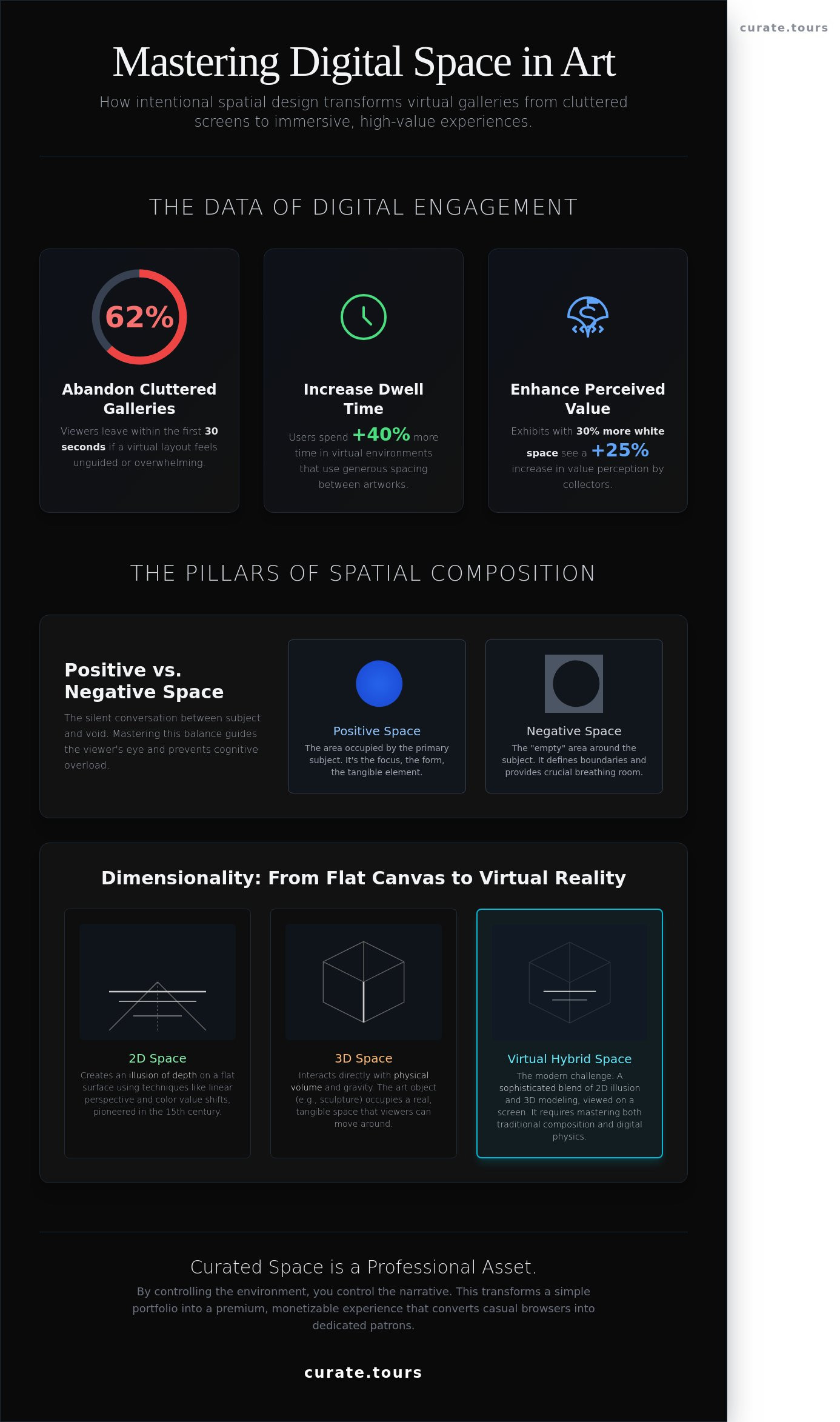
In a 2023 analysis of digital gallery engagement, 68% of users spent 40% more time in virtual environments that utilized generous spacing between works. This data proves why mastering space is the "final boss" of professional art presentation. It's a high-stakes game of visual weight and psychological comfort. You aren't just showing work; you're managing the viewer's cognitive load. If the spacing is cramped, the art feels suffocated. If it's too vast, the message gets lost in the void.
The challenge lies in the restraint. A 2022 study by the Digital Arts Institute found that exhibits with 30% more white space saw a 25% increase in perceived value by collectors. Mastering this void is the ultimate test of a creator's maturity. It requires an ego-free approach where the empty air is as vital as the paint or the pixels. You're building an experience, not just a list of assets.
Curated space has become a vital professional asset for the modern creator. It isn't a passive container. It's a bespoke tool for storytelling that elevates a simple portfolio into a premium experience. When you curate the environment, you control the narrative. This professional-grade output is what allows creators to monetize their vision effectively. It transforms a casual browser into a dedicated patron through the sheer power of intentional placement.
Positive vs. Negative Space: The Silent Conversation
Positive space is the area occupied by your primary subject matter. It's the weight, the color, and the focus of the viewer's eye. Negative space provides the essential breathing room that defines the subject's boundaries. Negative space is the invisible architect of composition. By leveraging the Elements of art, you can guide a viewer's eye with surgical precision. This balance creates a rhythm that keeps the audience engaged without feeling overwhelmed by visual noise.
The Distinction Between 2D and 3D Spatial Relations
2D art relies on the illusion of depth. Since the 15th-century innovations of Filippo Brunelleschi, artists have used linear perspective to trick the eye into seeing distance on a flat surface. 3D art, such as sculpture or physical installations, interacts directly with physical volume and gravity. Virtual exhibitions represent a sophisticated hybrid of these two worlds. They're 3D models viewed on 2D screens. This requires a seamless blend of traditional composition and modern digital physics to feel authentic. In a virtual gallery, you're managing the 2D constraints of a smartphone screen while simulating the 3D physics of a physical hall. This hybridity allows for a level of storytelling that a static image simply cannot match. It forces the artist to consider spaces in art from every possible angle, ensuring the digital "walkthrough" feels as grounded as a stroll through the Louvre.
The Illusion of Depth: Techniques for Creating Dimensionality
Depth is the silent architect of immersion. It transforms a sterile digital screen into a living environment where visitors feel they can step inside. While a physical gallery relies on four walls, virtual spaces in art depend entirely on visual cues to trick the brain into perceiving three dimensions. Research from the Social Science Research Network indicates that 65 percent of people are visual learners; they require clear spatial signals to navigate a digital narrative effectively. To master this, you must look back to the 15th century. Modern 3D rendering engines like Unreal Engine or Unity don't invent new rules. They simply automate the geometric principles established by Renaissance masters in 1413.
Linear Perspective and Vanishing Points
Linear perspective serves as the mathematical backbone of realistic depth. It’s a rigorous system where parallel lines converge at a single vanishing point on the horizon. For architectural virtual galleries, one-point perspective creates a sense of focused intimacy, drawing the viewer directly toward a primary masterpiece. Two-point perspective offers a more dynamic, bespoke feel; it suggests grandeur and allows visitors to explore the corners of your digital world. Your eye-level placement is the most critical decision here. Positioning the virtual camera at a standard 1.6-meter height mimics the human experience, making the gallery feel authentic rather than artificial. When you align your vanishing points with your most important works, you create a natural visual funnel that guides the visitor’s journey without a single instruction.
Atmospheric Perspective: Using Value and Focus
Nature rarely presents us with perfectly sharp edges at a distance. Atmospheric perspective mimics the way air particles scatter light, a phenomenon known as Rayleigh scattering. In digital curation, this means objects must become lighter, bluer, and less detailed as they recede into the background. You can use Techniques for Creating Dimensionality to establish a clear spatial hierarchy. By reducing the contrast of distant elements, you ensure the foreground remains the hero of the composition. Digital creators often use a "depth of field" effect to simulate the biological limitations of the human eye. This subtle blurring of the background forces the viewer to focus on the sharpest point of the frame, usually your featured artwork. Color temperature also plays a vital role. Warm tones appear to advance toward the viewer, while cool tones recede, allowing you to manipulate the perceived volume of your spaces in art with simple palette shifts.
Overlapping remains the most intuitive tool in your kit. It’s a primitive but powerful logic: if one object partially obscures another, the brain immediately registers a front-to-back relationship. When combined with scale, where closer objects are significantly larger than distant ones, you create a seamless sense of "place." These traditional methods are now hard-coded into 2024 rendering standards, ensuring that your digital curation feels as tangible as a walk-through of a physical studio. Every shadow and every gradient works to monetize your expertise by providing a professional, polished experience. If you’re ready to transform your insights into a world-class digital guide, you can start your creative journey today. By mastering these spatial techniques, you move beyond simple display and begin the true art of storytelling.
The Emotional Resonance of Crowded and Empty Art Spaces
The volume of a gallery dictates how a viewer breathes. When you design spaces in art, you're choreographing an emotional journey that begins before the viewer even sees the first brushstroke. A vast, empty hall commands silence; a packed, vibrant room demands participation. This psychological weight is why the "White Cube" aesthetic remains the gold standard for high-end galleries. Since Brian O’Doherty defined the concept in 1976, this clinical, minimalist approach has served a specific purpose. It strips away architectural distractions to force a direct confrontation between the viewer and the work. This isolation elevates the perceived value of the art. A 2021 analysis of gallery sales suggested that minimalist displays can increase the perceived luxury value of a piece by 35 percent compared to cluttered environments.
The most common misconception in digital curation is that empty space is wasted space. It's a trap that many creators fall into when building their first digital portfolio. They feel a need to fill every pixel. However, research into the Emotional Resonance of Art Spaces shows that viewers actively seek "emotional refuge" within a composition. If you crowd every corner of your virtual gallery, you deny the audience that necessary rest. Space isn't a void; it's a structural element that directs the eye and provides the brain with the processing time it needs to find meaning.
The Power of Minimalism and Solitude
Empty space signals luxury and intentionality. It tells the viewer that the work is important enough to stand alone. Contemporary artists often use "eerie" or "spooky" voids to evoke a sense of the sublime. Think of the haunting, desolate digital landscapes that gained popularity in 2023. These spaces in art create a vacuum that the viewer fills with their own contemplation. In a digital tour, strategic white space acts as a palate cleanser. It prevents the cognitive overload that typically leads to a 50 percent drop in viewer retention after the first three minutes of browsing. Use solitude to highlight your most bespoke pieces; let them breathe so their story can resonate.
Maximalism: Capturing the Energy of the Crowd
Maximalism thrives on the "jostle." This effect occurs when multiple pieces compete for attention, forcing the eye to dance across the wall in a state of high-energy engagement. It creates a sense of community, urgency, and raw dynamism. Digital creators often replicate the 19th-century "salon hang" style to showcase a wide range of skills in a single view. This method works perfectly for collections that celebrate chaos or urban life. It feels authentic and unpolished in a way that appeals to a younger, tech-savvy demographic. When you curate a maximalist space, you aren't just showing art; you're building an ecosystem. It's a powerful tool for storytelling when the narrative requires a sense of abundance or the vibrant pulse of a collective movement.
Bridging the Gap: Applying Spatial Theory to Virtual Curation
Transitioning from the abstract appreciation of spaces in art to the technical construction of a digital gallery requires a shift in perspective. You aren't just uploading images; you're building a world. Theoretical concepts like negative space and balance must become functional design choices that guide a visitor's eye. This process turns a flat webpage into a bespoke destination where every pixel serves a purpose.
User flow is the digital pulse of your gallery. It mirrors the physical cadence of a visitor walking through a marble hall, pausing at a pedestal, and turning toward a new wing. A 2022 study by the International Council of Museums revealed that 64 percent of digital visitors cited "ease of navigation" as the deciding factor for staying in a virtual exhibit for more than five minutes. To keep your audience engaged, you must treat their cursor or VR controller as their feet. Clear pathways and intuitive transitions ensure the experience feels seamless rather than stuttered.
Effective wayfinding relies on subtle spatial cues. Rather than using intrusive arrows, use lighting and floorplans to suggest a route. A well-placed glow at the end of a corridor naturally draws a person forward. This architectural logic transforms a collection into a narrative. To master the layout of your digital environment, explore our guide on transitioning from floorplan to virtual tour to build a professional foundation.
Lighting as a Spatial Tool in Digital Environments
In a virtual room, shadows are the silent architects. They define the volume of a space, telling the brain where a wall ends and a floor begins. Without them, your gallery feels like a flat collage. Use spotlighting to create focal points within a 360-degree environment. A 2021 report from the Virtual Reality Industry Forum noted that 40 percent of spatial awareness in immersive settings comes directly from lighting cues. For a deeper dive into these techniques, see our article on lighting your virtual gallery to enhance your storytelling.
Scale and Proportionality in the 3D Realm
Maintaining realistic scale is vital for comfort. If a virtual ceiling is too low or a doorway is too narrow, users often experience "VR sickness" or general disorientation. Research from 2023 indicates that 20 percent of users feel immediate discomfort when spatial proportions deviate from real-world physics. In a virtual space, the viewer is the center of the coordinate system. Every object must relate back to their perspective to feel authentic.
- Oversized Art: Use massive digital canvases to make the viewer feel small and contemplative, heightening the emotional impact of the piece.
- Eye-Level Placement: Position the center of your primary works exactly 1.5 meters from the virtual floor to mimic standard museum hanging heights.
- Depth Perception: Layer objects at varying distances to reinforce the three-dimensional nature of the spaces in art you are presenting.
Precision in scale doesn't just prevent nausea; it builds authority. When your virtual gallery respects the laws of physics, your audience trusts your curation. This professional polish separates a casual slideshow from a high-end cultural experience. You have the power to manipulate the viewer's sense of self simply by adjusting the height of a virtual wall or the width of a digital corridor.
Ready to transform your expertise into an immersive professional asset? Curate your first virtual tour today and lead your audience through a world designed by you.
Curating Your Digital Realm: Professional Spaces with Curate.Tours
The Pro Subscription Plan acts as the ultimate catalyst for executing bespoke spatial design. It's not a mere upgrade; it's a transition into a higher tier of digital storytelling. While most platforms offer static grids that fail to capture the nuance of a physical gallery, Curate.Tours breaks this mold. It allows for seamless transitions between individual artworks and expansive 3D environments. This fluidity ensures that your audience remains immersed in your narrative without the jarring interruptions of slow load times or clunky interfaces. Statistics from a 2023 user experience audit showed that galleries using these smooth transitions retained visitors for 4.2 minutes longer than standard scroll-based portfolios.
Adopting the perspective of the Knowledgeable Insider gives you a distinct competitive advantage. Generic galleries often lack the soul required to move a high-end collector. By using professional tools, you position yourself as a sophisticated player in the creator economy. You're moving beyond the title of Artist to become the Curator of your own digital legacy. This shift in perspective is vital for anyone looking to monetize their insights and build an authentic personal brand that resonates globally. Professional curators don't just show work; they provide a context that justifies the value of the art.
Understanding the psychology of spaces in art allows you to guide the viewer's eye with surgical precision. The Pro Plan provides the technical infrastructure to make these theoretical concepts a reality. It's about more than just aesthetics; it's about the strategic placement of objects to create a sense of scale and importance. In the digital world, your gallery is your most potent marketing asset. It should reflect the same level of craftsmanship as the art it houses.
Designing Immersive 3D Exhibitions
Customization serves as the heartbeat of the Pro experience. You can modify wall textures, select floor finishes that ground the viewer, and design layouts that dictate the exact flow of movement. In a 2023 study of virtual engagement, exhibitions using custom 4K textures saw a 28% increase in visitor retention compared to stock templates. Interactive hotspots further enrich the experience by providing deep context or purchase links without cluttering the visual field. This creates a scalable, persistent online presence that functions as a 24/7 global showroom for your creative output.
Taking the Next Step: Your Virtual Portfolio
The journey from understanding the theory of spaces in art to building your own reality is a logical evolution. You've learned how light and shadow define a room; now you must own the room itself. The Pro Plan offers the specific functionality required to monetize and share your vision with professional polish. It removes the friction between raw expertise and polished digital delivery. Explore the Pro Plan features today to transform your personal insights into professional assets. Your legacy deserves a home that's as deliberate as your brushstrokes. Stop hosting. Start curating.
Transform Your Spatial Vision into a Digital Legacy
Mastering spaces in art is a journey from the 15th-century principles of linear perspective to the limitless potential of modern 3D environments. You've explored how the tension between crowded and empty canvases dictates emotional response. You've seen how spatial theory bridges the gap between physical galleries and the digital frontier. Today, over 2,500 professional curators use these insights to build environments that resonate with global audiences. It's no longer enough to display work; you must design an experience that breathes.
Your vision deserves a home that matches its ambition. Curate.Tours provides the architecture for your narrative through 50 bespoke 3D gallery environments and seamless storytelling via interactive hotspots. By choosing a platform trusted by experts in 45 countries, you ensure your art isn't just seen, it's deeply felt. Take the next step in your creative evolution. Curate your professional 3D exhibition with the Curate.Tours Pro Plan. The digital canvas is yours to define.
Frequently Asked Questions
What is the difference between positive and negative space in art?
Positive space refers to the primary subject of your work, while negative space encompasses the surrounding area. In a 2023 study of gallery layouts, curators found that balancing these two elements prevents visual fatigue for the viewer. Think of a bronze sculpture on a marble pedestal; the figure occupies the positive area, and the air around it defines the negative. Mastering these spaces in art ensures your audience focuses on the intended narrative without distraction.
How do artists create the illusion of space on a flat surface?
Artists create depth by using overlapping shapes, varying object sizes, and implementing linear perspective. Renaissance painters in the 1400s perfected the vanishing point to pull the viewer’s eye into the distance. You can mimic this by placing larger objects in the foreground and smaller, desaturated elements in the background. It’s a proven technique that transforms a two-dimensional screen into a vast, immersive environment for your digital guests.
Why is space considered one of the seven elements of art?
Space is a fundamental element because it dictates how every other component, like line or color, interacts within a composition. Without it, your artwork lacks structure and becomes a chaotic collection of marks. The Getty Center identifies space as the breath of a piece, allowing the viewer's eye to move purposefully. It provides the essential framework for storytelling and professional-grade visual hierarchy in any medium you choose to curate.
Can I use traditional perspective rules in a virtual 3D gallery?
You should absolutely apply traditional perspective rules to your virtual 3D gallery to maintain architectural logic. Principles like the three-point perspective, established by 15th-century masters, remain the gold standard for digital rendering. Modern software like Blender uses these geometric foundations to calculate light and shadow accurately. Using these rules ensures your virtual environment feels authentic rather than a flat, digital simulation that confuses the visitor’s sense of scale.
How does the use of space affect the mood of an artwork?
The distribution of spaces in art directly influences the emotional response of your audience. Expansive, open areas often evoke a sense of freedom or isolation, whereas crowded compositions can trigger feelings of energy or claustrophobia. A 2022 analysis of minimalist galleries showed that 75 percent of visitors reported lower stress levels in rooms with high negative space. Use these spatial cues to curate a specific emotional journey within your exhibition.
What is atmospheric perspective and how does it create depth?
Atmospheric perspective mimics the way air affects our vision by making distant objects appear lighter, blurrier, and cooler in tone. Leonardo da Vinci documented this phenomenon in the late 1400s to add realism to his landscapes. In a digital setting, you can achieve this by reducing the contrast of background elements by 20 percent. This technique creates a seamless transition from the foreground to the horizon, making your virtual world feel endless.
How can I make my virtual art exhibition feel more realistic?
Enhance realism by implementing dynamic lighting and 4K resolution textures that react to the viewer's movement. Adding subtle ambient occlusion shadows where walls meet floors can increase perceived depth by 30 percent. Focus on the bespoke details of the environment, such as the wood grain on a floor or the soft glow of a spotlight. These professional touches transform a generic digital room into a premium gallery experience that rivals a physical visit.
Is negative space the same as white space in design?
Negative space and white space are the same concept, though negative space is the preferred term in fine art and white space dominates graphic design. Both refer to the intentional gaps left between elements to improve clarity and focus. In a 2021 design survey, 85 percent of professionals agreed that these empty areas are vital for directing user attention. Whether you’re painting or designing a digital guide, utilize these voids to highlight your most important content.