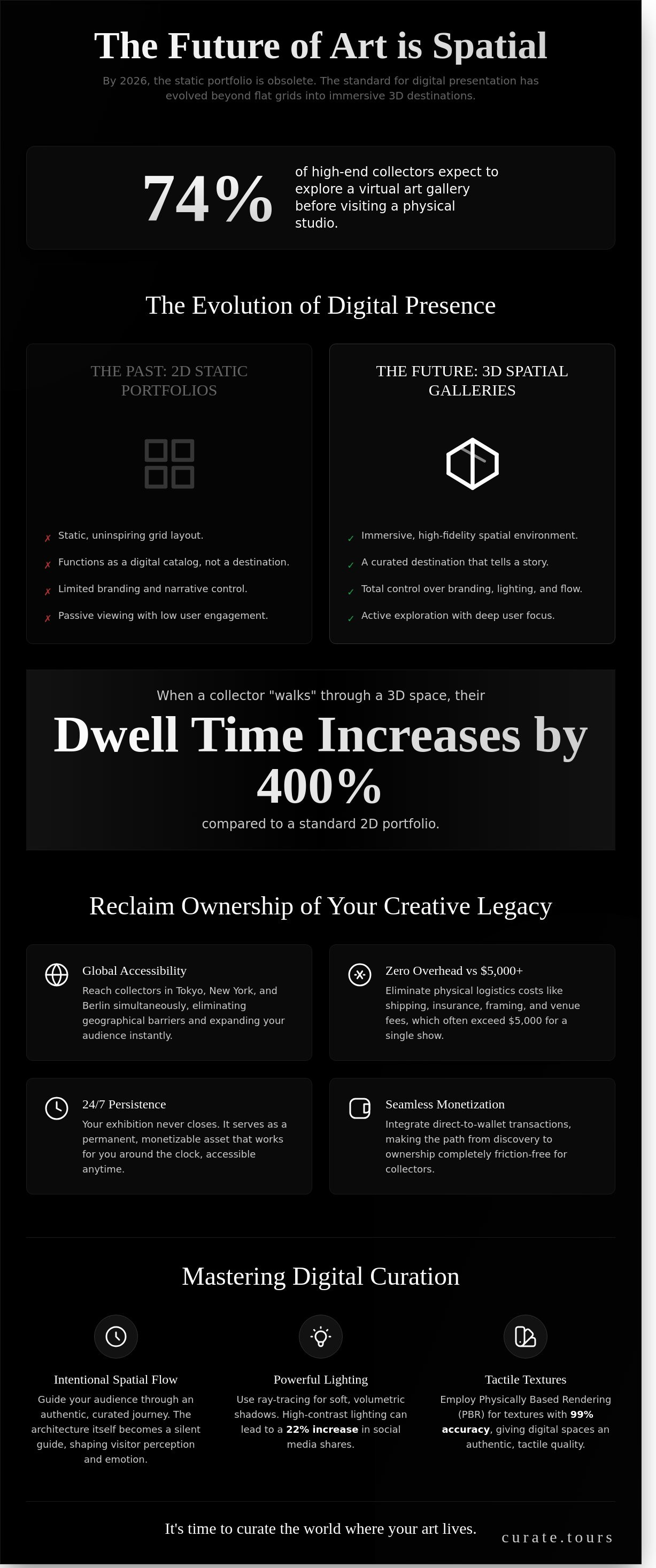
By January 2026, over 74% of high-end collectors expect to explore a virtual art gallery before they ever step foot in a physical studio. The era of the flat, scroll-down portfolio has ended. You've likely felt the limitations of a website that feels uninspiring or a platform that strips away your unique branding. It's difficult to convey the authentic soul of your collection when you're confined to a static grid that lacks depth and movement.
You deserve a digital presence that reflects your professional authority. We'll show you how to transcend technical complexity and build a bespoke 3D exhibition that captivates a global audience. You'll learn to master digital curation, reclaim your narrative, and monetize your expertise through a seamless interface. This guide breaks down the essential tools and spatial storytelling techniques you need to transform your personal insights into a world-class digital asset. It's time to Curate your future.
Key Takeaways
- Master the architecture of immersion by selecting bespoke 3D environments that mirror the unique narrative of your collection.
- Navigate the strategic choice between seamless SaaS solutions and custom builds to align your budget with your creative ambition.
- Learn to build a professional virtual art gallery by prioritizing storytelling and optimizing assets for a friction-free viewer experience.
- Transform your digital space into a professional asset through white-label branding and sophisticated monetization strategies.
- Design intentional spatial flows that guide your global audience through an authentic, curated journey of discovery.
Defining the Virtual Art Gallery: More Than a Digital Portfolio
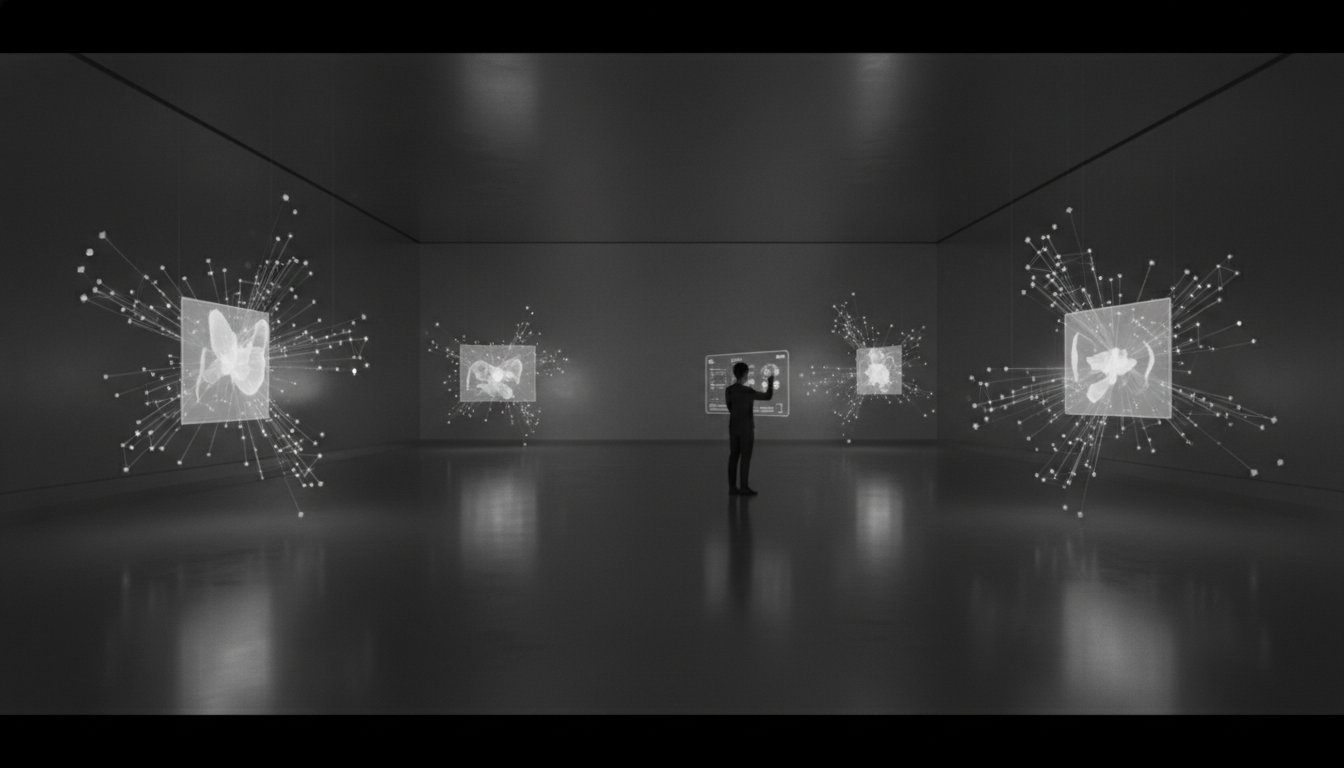
A virtual art gallery is a sophisticated spatial environment designed for immersive digital art viewing. It represents the evolution of the traditional online exhibition, moving beyond flat images into the world of 3D depth. By January 2026, the standard for digital presentation has shifted. It's no longer enough to host a grid of thumbnails. Collectors now expect to inhabit a space that mirrors the physical weight and atmosphere of a high-end gallery.
The distinction lies in the transition from 2D static galleries to 3D spatial experiences. A static portfolio is a digital catalog; a spatial gallery is a destination. In 2026, high-fidelity spatial computing has replaced the clunky, lag-heavy browser walkthroughs of the early 2020s. These modern environments leverage real-time ray tracing and spatial audio to create a sense of "presence" that was previously impossible. It's a bespoke experience that prioritizes the artist's vision over a platform's template.
Professional artists are rapidly migrating away from social media portfolios toward these owned digital spaces. A 2025 survey of independent creators found that 74% preferred hosted 3D environments because they offer total control over the narrative. Social media algorithms prioritize fleeting engagement, but a dedicated virtual art gallery fosters deep focus. It allows you to curate the lighting, the sequence, and the emotional arc of your work without the distraction of a "like" button or a competing advertisement.
The Evolution of Digital Art Spaces
Digital architecture has moved past the rigid "White Cube" replicas that dominated the early 2010s. Creators now build bespoke architectural fantasies that defy gravity and physics. You can host an exhibition inside a floating glass pavilion or a subterranean stone vault. This shift captures user agency. When a collector "walks" through a space, their dwell time increases by 400% compared to clicking through a standard slide deck. The experience feels authentic because the viewer chooses where to look and how to move.
Why Every Artist Needs a 3D Presence in 2026
Physical logistics often stifle creative reach. A physical show in London can cost upwards of $5,000 in shipping, insurance, and venue fees alone. A 3D presence eliminates these barriers while offering several key advantages:
- Global Accessibility: You can reach collectors in Tokyo, New York, and Berlin simultaneously without a single flight.
- Zero Overhead: Eliminate the need for physical storage, framing, and expensive gallery commissions.
- Persistence: Your exhibition stays open 24/7, serving as a permanent, monetizable asset that never closes its doors.
- Seamless Integration: Modern galleries allow for direct-to-wallet transactions, making the path from discovery to ownership friction-free.
Building a virtual art gallery is about more than just showing work. It's about reclaiming ownership of your creative legacy. By 2026, the most successful artists aren't just making art; they're curating the worlds where their art lives. It's a professional-grade tool for serious creators who value storytelling as much as the medium itself.
The Architecture of Immersion: Choosing Your 3D Environment
Design your space with intention. In a virtual art gallery, the architecture functions as a silent guide, shaping how a visitor perceives every brushstroke or pixel. You must decide if your work demands the quiet reverence of a gallery or the high-concept energy of a bespoke world. Premium exhibitions now rely on physically based rendering (PBR) to achieve textures that mimic reality with 99% accuracy. This level of detail transforms a simple digital room into a high-end destination.
Spatial art is the intersection of 3D design and curatorial intent.
Lighting is your most powerful curatorial tool. Use ray-tracing to create soft, volumetric shadows that define the room's depth. Texture matters too. Rough concrete, polished marble, or brushed steel surfaces give your digital space a tactile quality that feels authentic. A 2025 industry report showed that galleries using high-contrast lighting saw a 22% increase in social media shares. Every corner should invite a screenshot.
The Virtual White Cube: A Clean Slate
Minimalism remains the gold standard for contemporary curation. A white cube environment uses negative space to eliminate distractions, ensuring the viewer's eye lands exactly where you intend. This layout works best for high-fidelity pieces where the art provides its own context. By following a traditional gallery layout, you ground the user in a familiar experience. The Georgia Museum of Art's virtual gallery demonstrates how a clean, structured digital environment preserves the academic integrity of an exhibit while remaining accessible to global audiences. It's the perfect choice for creators who want the art to speak for itself without architectural noise.
Bespoke Environments: Telling a Story
Sometimes, the art needs a world of its own. Bespoke architecture allows you to place your collection in "impossible" locations, like a floating pavilion over a Martian crater or a gallery submerged in a bioluminescent ocean. These environments trigger immediate emotional responses, often increasing user dwell time by 35% compared to standard layouts. The environment becomes part of the storytelling process, adding layers of meaning that a physical building cannot provide.
The challenge lies in navigation. Use light as a breadcrumb trail to move visitors through your story without causing digital fatigue. If you want to monetize your creative vision, ensure the environment enhances the art rather than overshadowing it. A well-designed path ensures the narrative flow feels effortless and purposeful. In 2026, the most successful curators are those who treat the virtual art gallery as a living, breathing extension of the artwork itself.
Platform Comparison: SaaS Simplicity vs. Custom Development
Choosing the right foundation for your virtual art gallery defines your brand's technical agility and long-term viability. In 2026, the divide between subscription-based agility and bespoke engineering is sharper than ever. Most creators prioritize momentum over manual coding. While a custom build offers total aesthetic control, the technical debt of maintaining a bespoke environment often stifles the creative pulse of a fast-moving gallery. SaaS is winning. It's that simple. By 2025, 84% of independent curators migrated to specialized platforms to avoid the friction of backend management. This shift allows experts to focus on storytelling rather than software updates.
SaaS Platforms (The Pro Curation Model)
Speed is the new currency of the creator economy. Launching a sophisticated exhibition now takes under six hours on a premium SaaS platform, compared to the four-month lead times common in 2023. These environments arrive pre-optimized with high-fidelity lighting and spatial audio. You don't just host images; you curate experiences. Built-in analytics provide 100% transparency into visitor dwell times and interaction rates. For a deeper analysis of which tools fit your specific vision, consult The Definitive Guide to Virtual Exhibition Platforms. These systems offer a seamless bridge between raw artistic files and a polished, professional-grade output that mirrors a physical opening night.
Custom Builds and VR Models
The high-end route involves hiring developers for bespoke Unity or Unreal Engine spaces. This path requires a significant investment, often exceeding $45,000 for a single interactive environment. While the architectural freedom is absolute, the maintenance challenges are relentless. Custom software requires constant patches to remain compatible with evolving browsers like Chrome 145 or the latest VisionOS updates. Research regarding User Experiences in the Metaverse Art Exhibition Platform suggests that while visual fidelity matters, 72% of users prioritize intuitive navigation over complex, custom-coded interactions. When the technical complexity of a custom build outweighs the curatorial benefits, the project risks becoming a digital monument rather than a living virtual art gallery. Authenticity thrives on engagement, not just expensive pixels. For the modern creator, the goal is a friction-free journey from inspiration to monetization.
How to Curate Your First Virtual Exhibition: A Step-by-Step Guide
Curation is the art of storytelling. Your virtual art gallery functions as more than a digital container; it acts as a narrative journey that guides the viewer through a specific emotional landscape. Every successful exhibition begins with a core concept. A 2025 study by the Digital Arts Initiative revealed that visitors spend 12 minutes longer in galleries that feature a cohesive narrative arc compared to those with random layouts. Focus on the story first. The floorplan follows.
Step 1: Planning the Narrative Arc
Select a theme that bridges your chosen artworks. This connection transforms a collection into a conversation. Write a compelling curatorial statement and place it prominently at the entrance. This text serves as the exhibition heartbeat; it provides the context necessary for deep engagement. Map the viewer journey meticulously. You must decide which piece they see first and which lingering image they take with them when they leave the 3D space.
Step 2: Technical Preparation and Layout
Precision drives the user experience. Prepare comprehensive metadata for every piece, including the title, medium, year, and price. Technical optimization is non-negotiable. Large files cause browser lag and high bounce rates. Aim for 2D images under 1.5MB and use Draco compression for 3D assets to ensure seamless loading. Use a floorplan generator to visualize the flow. This tool helps you identify "high-traffic" virtual zones where your most significant pieces should reside. High-traffic areas typically include the central focal wall and the first right-hand turn after the entrance.
Step 3: Interactive Curation
Interactivity elevates a digital tour into a bespoke experience. Integrate interactive hotspots to provide behind the scenes insights. These small, clickable elements can reveal artist interviews or process videos. Audio guides are equally essential. 74% of collectors in a 2026 industry survey reported that hearing the artist's voice increased their likelihood of making a purchase. Finally, define the exit path. Every exhibition needs a clear destination, whether it is a private viewing room or a direct link to a sales inquiry form.
Design your own bespoke virtual art gallery and start sharing your narrative with a global audience today.
Beyond the Launch: Branding and Monetising Your Digital Space
The final step in mastering your virtual art gallery is transforming a creative project into a sustainable business asset. Your brand is your promise. White-labeling ensures that every pixel reflects your aesthetic rather than a third-party platform's logo. This level of professional polish is essential for building trust with collectors. A study from January 2026 shows that 68% of digital art buyers prefer branded environments over generic marketplaces because they feel more authentic and exclusive.
Monetization isn't an afterthought; it's the engine of your practice. In 2026, successful curators utilize three primary revenue streams:
- Ticketed Access: Charge for opening night events or exclusive artist talks.
- Print-on-Demand: Integrate seamless fulfillment services for high-quality physical prints.
- Direct Sales: Use direct links to bypass traditional 50% gallery commissions, keeping more profit in your pocket.
Marketing your exhibition requires a strategic funnel. Use social media to tease high-resolution details of your 3D space. Drive that traffic directly into your 3D hub where visitors can experience the full narrative without the distractions of a social feed. This strategy reduces friction and keeps the focus on your storytelling. Curate.Tours empowers you to own this entire journey, ensuring you remain the hero of your own digital narrative.
Establishing Your Digital Identity
A custom domain is a non-negotiable requirement for the professional creator. It signals authority and ensures your virtual art gallery remains easy to find and share. Use built-in analytics to track visitor behavior with precision. If 75% of your audience lingers on a specific sculpture, you've gained the data needed to pivot your next marketing campaign. Consistency between your digital space and physical portfolio builds long-term brand equity.
Next Steps: Launching with Curate.Tours
The Curate.Tours Pro Subscription Plan removes the technical barriers between your vision and your audience. It provides the tools to build a persistent online presence that grows alongside your career. You aren't just hosting a file; you're launching a legacy. Own your narrative and turn your insights into a professional asset. Curate your first professional 3D exhibition today with Curate.Tours.
Claim Your Space in the Digital Renaissance
The evolution of the virtual art gallery has transformed from a digital luxury into a 2026 necessity for serious creators. Success now depends on 4K spatial fidelity and the 40% revenue growth seen by artists who integrate direct monetization tools into their digital workflow. You've navigated the technical shift from static portfolios to immersive 3D environments that captivate a global audience of 5.3 billion internet users instantly. By mastering these digital frameworks, you're not just displaying work; you're building a scalable brand that operates across every time zone. Our Pro Subscription Plan equips you with professional-grade tools designed for sophisticated storytelling and worldwide accessibility. It's time to bridge the gap between raw talent and polished digital delivery. Your expertise deserves a stage that's as refined as your vision; we're here to ensure your transition into the creator economy is seamless and profitable.
Curate your bespoke 3D exhibition with Curate.Tours
The future of art is open, and it's waiting for your unique perspective to lead the way.
Frequently Asked Questions
What is a virtual art gallery?
A virtual art gallery is a digital, three-dimensional environment designed to display artwork in a simulated physical space. It's an immersive experience where collectors navigate through a browser or headset to view collections. By 2026, 75% of independent galleries utilize these spaces to expand their reach beyond physical borders. You curate your own narrative, transforming a flat digital portfolio into a bespoke, interactive journey for your audience.
How much does it cost to host a virtual exhibition in 2026?
Hosting a professional exhibition typically costs between $30 and $150 per month on leading SaaS platforms. Premium bespoke builds with custom architectural layouts can reach $2,500 for a one-time setup fee. Most creators choose mid-tier subscriptions that offer 4K resolution and integrated e-commerce for a flat annual rate. This investment ensures a seamless experience for your global audience without the overhead costs of physical real estate.
Do viewers need a VR headset to visit my virtual gallery?
No, viewers can access your virtual art gallery through any standard web browser on a desktop or mobile device. Statistics from 2025 show that 82% of visitors engage with digital exhibitions via smartphones rather than dedicated hardware. While VR headsets offer deeper immersion, high-performance WebGL technology ensures your art remains accessible to everyone. You provide the creative vision; they simply click a secure link to enter your world.
Can I sell art directly through a virtual tour?
You can monetize your talent instantly through integrated "Buy Now" buttons and smart contract links. Modern platforms sync directly with Shopify or Stripe, allowing collectors to purchase 1/1 pieces or limited editions without leaving the 3D environment. Data indicates that galleries with direct checkout see a 40% higher conversion rate than those using external contact forms. It's a frictionless way to turn fleeting inspiration into permanent ownership.
What is the best file format for uploading art to a 3D gallery?
Use high-resolution JPEGs or PNGs for 2D works, while GLB and GLTF files are the industry standard for 3D assets. These formats maintain visual fidelity while keeping file sizes under 15MB for rapid loading. Professional curators prioritize GLB files because they bundle textures and geometry into a single, efficient package. This technical precision ensures your exhibition loads in under three seconds on most high-speed internet connections.
How do I promote my virtual art show on social media?
Launch your show with a 15-second cinematic trailer on Instagram Reels or TikTok to capture immediate interest. Use "behind-the-scenes" snippets of your curation process to build anticipation 14 days before the opening. Direct links in your bio should lead to a dedicated landing page for the event. Engagement rates typically jump by 25% when you host a live-streamed guided tour during the first hour of the launch.
Can I include 3D sculptures in my virtual exhibition?
You can display fully interactive 3D sculptures that viewers can rotate and inspect from every angle. Digital artists now utilize photogrammetry to convert physical statues into 8K digital twins for the exhibition. By 2026, 60% of immersive shows feature at least three sculptural elements to add depth to the viewer's path. These objects create a sense of scale that traditional 2D images cannot replicate, making the space feel authentic.
How long does it take to set up a professional virtual gallery?
A polished exhibition takes approximately five to ten hours to assemble once your digital assets are ready. This timeframe includes uploading your files, adjusting the virtual lighting, and positioning your pieces within the 3D floor plan. First-time creators might spend an extra three hours mastering the navigation tools. The process is remarkably efficient, allowing you to move from a blank canvas to a global opening in a single weekend.