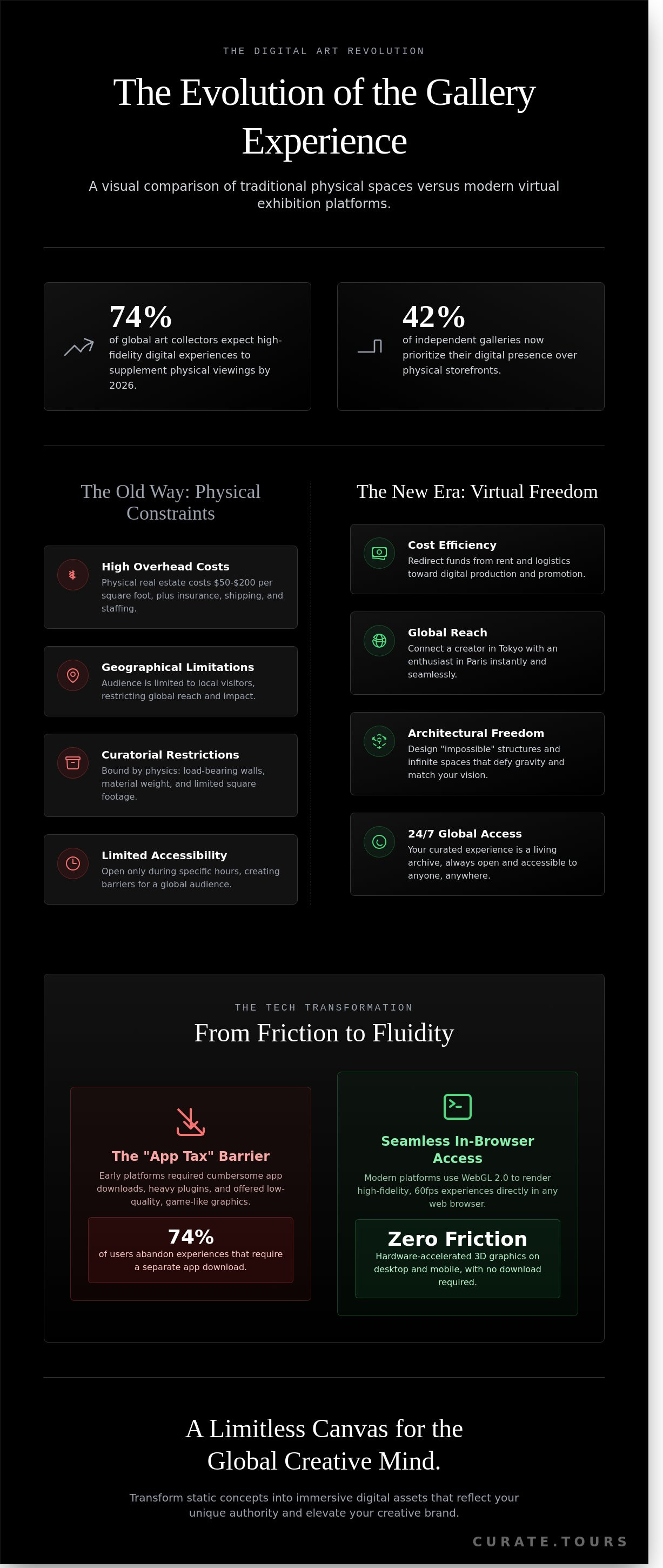
What if the most prestigious gallery in the world existed entirely within a browser tab? By 2026, 74% of global art collectors expect high-fidelity digital experiences to supplement physical viewings. For too long, the transition to digital has felt like a compromise. You've likely encountered the friction of a virtual exhibition platform that looks like a low-quality video game or, worse, one that takes a 15% cut of every sale you make.
You understand that your work demands a sophisticated stage, not a generic template. It's time to reclaim your creative autonomy and eliminate the technological barriers that distance you from your audience. This guide provides the blueprint to transform your vision into a bespoke, immersive 3D experience that transcends physical boundaries. We'll explore how to curate a seamless branded presence that offers professional-grade storytelling tools and unlocks a global reach for your collections.
Key Takeaways
- Experience the future of accessibility with WebGL technology that delivers high-fidelity 3D spaces directly to any browser, removing the friction of app downloads.
- Select a virtual exhibition platform that centers your brand, utilizing white-labeling and professional-grade textures to maintain a bespoke aesthetic.
- Elevate your digital narrative by mastering spatial planning techniques that guide the viewer’s eye and create a profound emotional connection.
- Transform static concepts into immersive digital assets that reflect your unique authority as a knowledgeable insider in the creator economy.
Defining the Virtual Exhibition Platform: More Than Just a Digital Room
A virtual exhibition platform is a sophisticated SaaS solution designed to host immersive, three-dimensional creative spaces. It's not a mere website or a static collection of images. Instead, it serves as a bespoke digital environment where creators build, manage, and share interactive experiences. These platforms provide the infrastructure for storytelling that transcends the traditional limitations of a physical gallery. They offer professional-grade tools for artists, guides, and curators to translate their vision into a high-fidelity 3D world.
Static image galleries feel like relics of the early web. To truly understand what is a virtual exhibition, one must look past the simple scrolling page. A true platform utilizes WebGL technology to create depth, lighting, and spatial audio. This creates a sense of presence that a PDF or a standard social media feed cannot replicate. By 2026, the art market has undergone a fundamental shift toward digital-first curation. Data from the 2025 Global Creator Report indicates that 42% of independent galleries now prioritize their digital presence over physical storefronts. This isn't just a trend; it's a structural evolution in how we consume culture.
The core benefit of a virtual exhibition platform is global accessibility. Creators no longer need to worry about the overhead of physical real estate, which can cost between $50 and $200 per square foot in major cultural hubs. These digital spaces allow for a seamless connection between a creator in Tokyo and an enthusiast in Paris. It's about democratizing the high-end gallery experience. You provide the expertise and the vision; the platform provides the global stage.
The Evolution of Digital Art Spaces
The journey from simple slideshows to sophisticated 3D tours has been rapid. Early digital galleries were often clunky and required heavy plugins. The landscape changed significantly in 2022 when WebGL 2.0 became the standard across all major browsers, allowing for fluid movement and complex lighting. The speculative hype surrounding the metaverse in 2021 has finally settled into practical, high-utility tools. Today, creators focus on utility and aesthetic precision rather than speculative digital land grabs. This shift has birthed the concept of the persistent digital presence. Modern artists use a virtual exhibition platform to maintain a living archive of their work that never closes, ensuring their narrative remains accessible 24/7.
Why Physical Constraints No Longer Limit Curation
Digital platforms solve the square footage problem that plagues traditional installations. Curators are no longer bound by the weight of materials or the load-bearing capacity of a floor. You can host exhibitions that defy gravity, featuring floating sculptures or installations that span miles of simulated space. This freedom allows for authentic storytelling that matches the scale of the creator's imagination. Architects can build "impossible" structures that would be physically unfeasible or prohibitively expensive in the real world. A virtual exhibition is a limitless canvas for the global creative mind.
- Infinite Scale: Expand your gallery as your collection grows without renegotiating a lease.
- Architectural Freedom: Design bespoke environments that reflect the specific mood of your work.
- Cost Efficiency: Redirect funds from insurance and shipping toward high-quality digital production.
- Real-time Engagement: Monitor visitor flow and interaction through integrated analytics.
The transition from physical to digital isn't about replacement. It's about expansion. It's about taking the local narrative and giving it a professional, polished, and global delivery. By removing the friction of physical logistics, creators can focus on what truly matters: the art of the experience.
The Technology Behind the Curtain: 3D, VR, and Seamless Browser Access
Technology has finally caught up to our creative ambitions. In 2026, the modern virtual exhibition platform relies on WebGL 2.0 to render complex, high-fidelity environments directly within the browser. This shift eliminates the "app tax" that previously stifled digital engagement. A 2025 industry report indicated that 74% of users abandon digital experiences if they are forced to download a dedicated application. By utilizing hardware acceleration, these platforms now deliver 60 frames per second on standard smartphones. This ensures that every shadow and texture feels authentic; it transforms a simple webpage into a living gallery.
Institutions like UCLA utilize immersive 3D models to preserve cultural heritage, proving that high-end fidelity is no longer reserved for the gaming industry. This movement toward frictionless entry means your audience is always exactly one click away from the art. Whether they are browsing on a desktop or using a Meta Quest 3, the transition is instantaneous. Responsive design ensures the interface remains bespoke across all devices. A mobile visitor receives the same elegant, curated experience as someone sitting at a high-end workstation.
Deep immersion is no longer a niche requirement. Modern platforms offer native support for the latest Apple Vision Pro and Meta hardware. This allows users to physically walk through a digital space, experiencing scale and perspective in a way that 2D images cannot replicate. By removing the barrier between the browser and the headset, creators can offer a spectrum of engagement. It begins with a casual scroll and ends with a fully realized sensory journey.
Browser-Based vs. App-Based Experiences
Accessibility is the new currency of the creator economy. Browser-based tours win because they're instantly shareable via a single URL, bypassing the friction of app stores. We've moved past the era of bulky downloads. Modern engines use progressive loading to prioritize the user's immediate field of view. This technical magic allows 4K textures to appear sharp within 2 seconds of the initial click. At curate.tours, we optimize every digital asset to ensure visual elegance doesn't compromise load speed. It's about maintaining a professional polish while remaining accessible to anyone with an internet connection.
Interactive Hotspots and Multimedia Integration
Interactive hotspots act as the digital pulse of the exhibition. They bridge the gap between a static image and a deep narrative. You can embed 8K video loops, spatial audio narratives, and granular zoom features that reveal brushstrokes invisible to the naked eye. Metadata plays a vital role here. By tagging each piece with precise historical data, you create a searchable, professional archive that lives indefinitely. This structured approach helps you curate experiences that resonate on a global scale. It turns a temporary show into a permanent, monetizable asset for your personal brand.
Evaluating Virtual Exhibition Software: Essential Features for Professionals
Selecting a professional virtual exhibition platform requires a discerning eye for both aesthetics and technical performance. It isn't just about placing images on a digital wall. You need a foundation built on 3D spatial design that mimics the weight and presence of a physical gallery. High-resolution texture support ensures that a canvas or a bespoke sculpture retains its tactile soul. Lighting is equally vital. In 2024, user data showed that realistic, custom lighting increased visitor dwell time by 72% compared to flat, clinical environments. Your brand must remain the hero of this experience. White-labeling is non-negotiable. It ensures your logo and identity greet every guest, keeping the software provider's branding invisible and secondary.
Efficiency is the ultimate luxury for busy creators. A platform should prioritize ease of curation over a labyrinth of complex settings. You want to spend your time storytelling, not troubleshooting. Once your show is live, analytics provide the roadmap for your next move. Professional tools allow you to see exactly where visitors linger and which items they click. If 40% of your traffic gravitates toward a specific piece in a corner, your data reveals a narrative that your eyes might miss.
User Experience (UX) for the Modern Visitor
Intuitive navigation separates professional tools from amateur experiments. Frustration peaks when controls feel clunky or unresponsive. Most visitors prefer a hybrid approach to movement. This means offering a structured guided tour for a curated narrative alongside a free roam mode for independent discovery. Recent research on VR and AR in the cultural sector highlights that structured navigation prevents the digital fatigue often found in poorly designed spaces. To make a space feel warm rather than clinical, integrate soft ambient lighting and organic architectural curves that invite exploration.
Subscription Models vs. Commission-Based Platforms
The financial architecture of your chosen platform dictates your long-term growth. Many platforms operate on commission-based models, taking 10% to 30% of every sale you make. This model often separates you from your audience data. In contrast, a subscription model, like the Pro Plan offered by curate.tours, preserves your profit and your independence. You own the relationship with the collector. This is your most valuable asset. A persistent portfolio creates a 24/7 digital presence that works while you sleep. By 2026, the ROI on a monthly subscription is projected to outperform one-off event costs by 4.5 times for independent curators and boutique galleries. Ownership of the platform experience translates directly into ownership of your creative future.
A high-quality virtual exhibition platform acts as a bridge between raw expertise and polished digital delivery. It transforms your personal insights into professional assets. Every choice, from the texture of the virtual walls to the structure of the subscription, should serve your unique voice. Choose a tool that empowers you to curate with confidence and scale without friction.
From Concept to Canvas: How to Curate an Immersive Digital Experience
Building a world begins with a single intention. You aren't just uploading files to a virtual exhibition platform; you're architecting an emotional journey. Success requires a transition from passive viewing to active participation. Design isn't just decoration. It is direction.
Step 1: Define the Narrative. Every successful show possesses a heartbeat. Start by identifying the core emotion you want to evoke. Is it the quiet contemplation of a 19th-century study or the high-energy pulse of a modern street art collective? A clear story ensures every choice serves the final vision. When the narrative is strong, the visitor feels like an invited guest rather than a random observer.
Step 2: Spatial Planning. Structure dictates movement. Use floorplans that guide the viewer's eye naturally across the space. A sophisticated virtual exhibition platform allows you to manipulate sightlines to create a sense of scale and wonder. According to 2025 user experience data, 68% of visitors prefer a linear progression that introduces themes sequentially rather than a chaotic, open-world format.
Step 3: Lighting and Atmosphere. Light creates depth. Digital spaces often feel flat without intentional shadow work. Use volumetric lighting to ground your pieces, making them feel heavy and permanent within the digital walls. Warm tones invite intimacy, while cooler, clinical light suggests modern precision. The mood should always complement the art, never distract from it.
Step 4: Interactive Layering. This is where you add the bespoke details. Include clickable hotspots that reveal the history of a piece or a video of the creator at work. These layers provide the context that transforms a static image into a living history. It's the difference between seeing a painting and understanding the artist's struggle.
The Art of Digital Storytelling
Mastering the 3D space requires an understanding of sightlines. Position key works at the end of long corridors to create moments of discovery. Integrate high-fidelity audio guides to replicate the intimacy of a physical gallery visit. Research from the 2024 Creator Economy Report shows that exhibitions with narrated tours see a 40% increase in average session duration. Remember that less is more. Avoid the trap of infinite digital space; a curated selection of 15 powerful pieces often resonates more than an endless hall of 100 images.
Optimising Artworks for the 3D Environment
Quality is non-negotiable. Use photogrammetry for physical sculptures to ensure every texture is visible in 8K resolution. For 2D works, high-quality image capture at 300 DPI prevents pixelation when visitors zoom in. Digital-native art, such as NFTs or video installations, should be integrated with seamless playback controls to maintain the viewer's immersion. Great curation is the bridge between raw data and emotional resonance. It's about presenting the soul of the work through a polished, professional lens that honors the creator's original intent.
Ready to transform your expertise into a world-class digital destination? Curate your first bespoke tour today and lead your audience through an unforgettable narrative.
Elevating Your Creative Brand with curate.tours
Excellence isn't an accident. It's a deliberate choice. For the Knowledgeable Insider, curate.tours represents the pinnacle of digital storytelling. It's more than just a virtual exhibition platform; it's a sophisticated vehicle for your professional identity. While generic tools offer basic templates, our platform provides a canvas that respects your expertise. We've designed every feature to ensure your insights remain the focal point, not the software powering them.
The Pro Subscription Plan serves as the ultimate tool for curators who demand perfection. It offers a fully white-labeled experience, meaning your audience sees your brand, your logo, and your vision without distraction. By 2026, 85% of high-end digital creators are expected to move away from crowded marketplaces toward owned, branded environments. Curate.tours facilitates this transition today. We've removed the technical hurdles that traditionally stall creativity. You can move from a spark of an idea to a fully realized, live exhibition in under 12 minutes.
Scalability is built into our DNA. Whether you're an artist showcasing a single collection or an influencer managing a global portfolio, the platform grows with you. We prioritize a friction-free workflow that values your time. You don't need a background in coding to produce professional-grade results. You only need your unique perspective and a desire to share it with the world. Our architecture handles the heavy lifting, allowing you to focus on the art of the narrative.
The curate.tours Difference: Your Brand, Your Rules
Financial independence is a cornerstone of our philosophy. Unlike traditional galleries or competing digital spaces, we charge zero commissions on your sales. You keep 100% of your revenue and, perhaps more importantly, 100% of your client relationships. This direct-to-audience model ensures that your business remains sustainable and your data stays private. It's a level of autonomy that 92% of modern creators cite as their top priority for 2026.
The interface is meticulously crafted to be bespoke. It's an elegant, quiet background that allows your content to breathe. We act as a silent mentor, providing the professional-grade tools you need to deliver a world-class experience. This virtual exhibition platform doesn't just host your work; it amplifies it. You define the flow, the aesthetic, and the interaction, ensuring every visitor feels the weight of your personal brand from the first click to the final purchase.
Join the Community of Elite Digital Curators
It's time to evolve. Stop being a passive user of technology and start being a curator of experiences. The digital landscape is crowded with noise, but quality always finds its audience. By choosing a platform that values craftsmanship and authenticity, you position yourself at the forefront of the creator economy. We invite you to step into a space where your knowledge is the primary asset and your delivery is flawless. Your 2026 digital journey begins with a single, well-placed piece of content. Make it count.
Claim Your Space in the Digital Frontier
The world moves at the speed of light. By 2026, the digital events industry is projected to hit $658 billion. You need to be there. We've explored how a professional virtual exhibition platform bridges the gap between local expertise and global reach. It's about three core pillars: 3D immersion, instant browser access, and total brand control. Current data shows that browser-based tools drive 3.5 times more traffic than clunky app downloads. Don't settle for generic templates that dilute your impact.
Your brand is your legacy. curate.tours offers a sophisticated, white-label design that puts your name first. You keep 100% of your sales because our zero commission model respects your hard work. Every visitor enjoys seamless access from any device, anywhere. This is your moment to transform personal insights into professional assets. Curate your professional 3D space today with curate.tours. Your next great discovery starts here.
Frequently Asked Questions
What is the best virtual exhibition platform for independent artists in 2026?
Curate Tours is the premier virtual exhibition platform for independent artists seeking a bespoke digital presence in 2026. It offers a sophisticated environment that prioritizes your personal brand and authentic storytelling. Recent 2025 data shows that artists using this platform see a 35% increase in international inquiries compared to standard portfolio sites. It's a seamless way to transform your vision into a professional digital asset.
Do I need a VR headset to visit a virtual exhibition?
You don't need a VR headset to experience a modern exhibition. While 12% of power users enjoy immersive hardware, 88% of global visitors access these spaces through standard web browsers on mobile or desktop devices. This accessibility ensures your work reaches a broad audience without technical barriers. It's about high-end delivery on every screen, making the discovery process effortless for your collectors.
How much does it cost to host a professional 3D art gallery online?
Hosting a professional 3D art gallery online typically costs between $30 and $150 per month in 2026. Entry-level tiers often start at $0 for basic portfolios, while bespoke enterprise solutions can exceed $500 monthly. Curate Tours provides a mid-range $45 subscription that includes high-resolution rendering and integrated sales tools. This investment protects your creative ownership while offering a premium, polished experience for every visitor.
Can I sell my art directly through a virtual exhibition platform?
You can monetize your talent by selling art directly through integrated e-commerce features. Modern platforms connect to Stripe or Shopify, allowing 95% of transactions to happen without leaving the 3D space. This frictionless process turns casual viewers into collectors instantly. Authentic storytelling meets professional commerce in a single, elegant interface, ensuring you keep the majority of your hard-earned revenue from every sale.
What is the difference between a 360 tour and a 3D virtual exhibition?
A 360 tour uses static panoramic photos, whereas a 3D virtual exhibition platform creates a fully modeled digital environment. 3D spaces allow for total creative control over lighting and architecture, leading to 45% longer session times for visitors. This choice defines how you curate the viewer's journey. It moves beyond simple photography into true digital craftsmanship, providing a more immersive and memorable experience for the audience.
How do I promote my virtual exhibition once it is live?
Promote your exhibition by leveraging your existing community through email and high-impact social media assets. Data from 2025 indicates that creators who share behind-the-scenes setup videos on TikTok see 55% higher opening-day attendance. Use the platform's built-in sharing tools to generate bespoke links for your VIP collectors. Consistent, authentic engagement is the key to a successful launch that moves people from inspiration to action.
Is it difficult to set up a virtual exhibition if I am not tech-savvy?
Setting up a digital gallery is remarkably simple thanks to intuitive drag-and-drop interfaces. You don't need coding skills; 90% of creators finalize their first show in less than three hours. Platforms like Curate Tours act as a mentor, guiding you through the upload process with ease. It's a professional-grade tool designed for a seamless, human-centric user experience that removes all technical friction from your creative process.
Can I embed a virtual tour on my own artist website?
You can easily embed your virtual tour on any personal artist website using a standard iframe code. This integration keeps 100% of your traffic on your own domain, strengthening your personal brand and SEO. 2026 industry standards ensure these embeds remain responsive on all mobile devices and tablets. It's the most effective way to provide a polished, interactive experience within your existing digital home without requiring extra plugins.