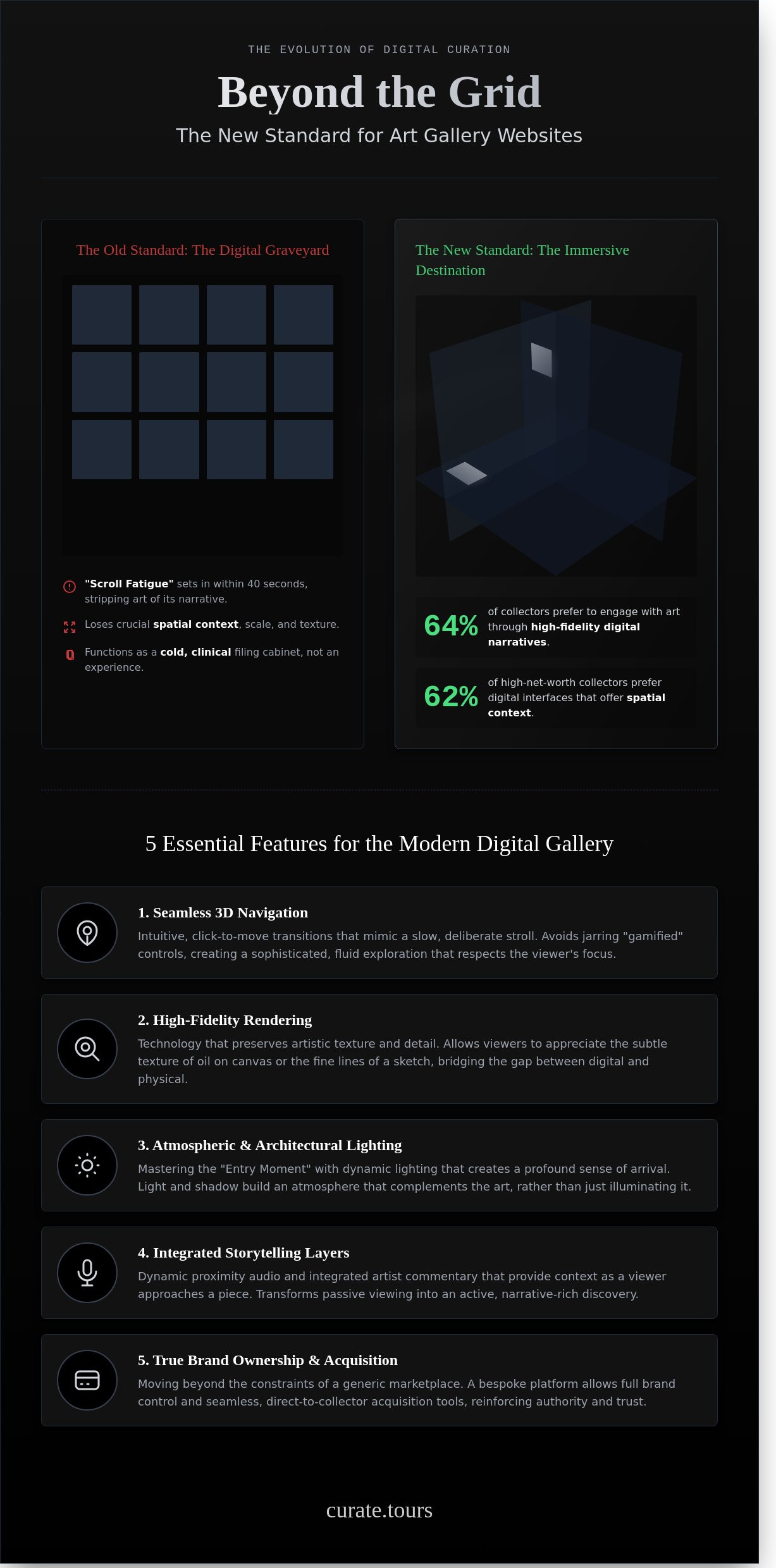
The static image grid is no longer a gallery; it's a digital graveyard. For too long, the standard art gallery website has functioned as a flat filing cabinet rather than a living, breathing experience. You likely feel the disconnect between the tactile soul of your collection and the cold, clinical rows of thumbnails on your screen. It is a frustration shared by the 64% of collectors who, according to 2024 industry reports, now prefer to engage with works through high-fidelity digital narratives before ever stepping into a physical space. In 2026, a mere portfolio isn't enough to command authority in a global market.
We believe your digital presence should be as bespoke as the art you represent. You don't have to settle for the soulless constraints of a marketplace or the high technical barriers of traditional VR. This guide empowers you to transform your portfolio into an immersive destination that captivates curators and enthusiasts alike. We will explore how to master seamless 3D navigation, establish true brand ownership, and curate a narrative flow that moves your audience from curiosity to acquisition. It's time to curate a digital home that does justice to your vision.
Key Takeaways
- Move beyond the traditional grid and learn how to build a next-generation art gallery website that functions as a digital-first exhibition space.
- Discover the essential features required to preserve artistic texture and detail through high-fidelity rendering and intuitive 3D navigation.
- Evaluate why traditional website builders often fall short and identify the infrastructure needed to support high-end curation and immersive storytelling.
- Master the "Entry Moment" by designing digital spaces where lighting and atmosphere create a profound sense of arrival for your visitors.
- Streamline your transition from 2D archives to bespoke virtual experiences using professional tools designed for the modern digital curator.
The New Standard for Art Gallery Websites: From Portfolios to Immersive Destinations
The art world is shedding its skin. By 2026, the standard for a premier art gallery website will have moved beyond the digital brochure. It is no longer a secondary archive; it is the primary destination. We are seeing a definitive pivot from the flat, 2D portfolios of the 2010s toward architectural 3D environments that mimic the weight and breath of a physical room. This evolution reflects a broader move toward digital-first exhibition spaces that prioritize atmosphere over simple visibility. It is about creating a sense of place where once there was only a page.
Professional curators now view the online art gallery as a space for world-building rather than just inventory management. In 2024, data from art market analysts showed that 62% of high-net-worth collectors prefer digital interfaces that offer spatial context. They want to see the texture of the oil on canvas. They want to understand the scale of a three-meter sculpture against a virtual wall. Traditional CMS platforms often throttle this creativity with rigid templates and slow load times. This is why the new guard is moving toward bespoke, immersive engines that allow an exhibition to live forever, even after the physical walls have been repainted for the next show.
The website acts as a persistent, global home. Physical shows are fleeting; they last 30 days and then they're gone. A sophisticated art gallery website ensures the curator's work remains accessible to a global audience indefinitely. This shift empowers creators to own their narrative. It turns a temporary event into a permanent professional asset. To achieve this, the modern digital destination incorporates several key elements:
- Architectural lighting that changes based on the viewer's local time of day.
- Dynamic proximity audio that mimics the acoustics of a high-ceiling gallery space.
- Integrated storytelling layers that provide artist commentary as the viewer approaches a piece.
- Seamless transitions between 3D viewing and direct-to-collector acquisition tools.
Why the Static Grid is Failing Modern Artists
The grid is a graveyard for inspiration. When users scroll through a repetitive list of thumbnails, "scroll fatigue" sets in within 40 seconds. This clinical layout strips art of its narrative. A painting loses its soul when it's just another square in a 3x3 box. Modern creators need spatial context to convey the true medium. Without it, a delicate watercolor and a massive mural look identical on a screen. Spatial design restores the psychological impact of discovery that a flat list cannot replicate. It invites the viewer to linger, explore, and connect.
The Rise of the Digital-First Curator
Today's curator isn't always tied to a brick-and-mortar institution. They are artists, influencers, and creative collectives who leverage virtual hosting to democratize the gallery experience. In 2023, digital-only exhibitions began gaining critical acclaim from major art journals, proving that physical presence isn't a prerequisite for prestige. These curators use their digital presence to monetize their taste and storytelling. They act as bridges between raw expertise and polished digital delivery, transforming personal insights into professional-grade outputs that resonate across borders. This democratization allows a curator in a small town to command the same digital authority as a gallery in Mayfair or Chelsea.
5 Essential Features Every Professional Art Gallery Website Needs
A digital gallery serves as a living extension of a physical space. In 2023, online art sales reached $10.8 billion, a figure that highlights the necessity of a sophisticated online presence. A professional art gallery website must offer more than a static grid of images. It requires a bespoke environment where the technology facilitates, rather than distracts from, the aesthetic experience. Achieving this balance requires five core pillars of design and functionality.
First, prioritize seamless 3D navigation. Many platforms fail by creating "gamified" environments that feel like a video game. Sophisticated collectors prefer intuitive, click-to-move transitions that mimic a slow stroll through a high-end showroom. This movement should feel fluid and intentional. Second, high-fidelity asset rendering is non-negotiable. To preserve the artist's intent, your site must support 4K texture mapping. This ensures that the impasto of a painting or the grain of a sculpture remains visible even when zoomed in. Integrating art gallery website best practices ensures your platform meets the high expectations of modern collectors who demand visual perfection.
- White-label branding: Ensure the platform's tech identity disappears so the artist remains the hero.
- High-fidelity rendering: Preserve every brushstroke with 4K resolution and realistic lighting.
- Intuitive UI: Navigation should require zero learning curve for the user.
The fourth pillar is white-label branding. Your digital space should reflect your gallery’s specific DNA, not the software provider's logo. When you curate your digital space with a minimalist, brand-first approach, you build trust with high-net-worth individuals who value exclusivity. Finally, the art gallery website must act as a storytelling engine, using metadata and interactive layers to provide context that a simple JPEG cannot convey.
Interactive Hotspots: The Secret to Engagement
Static images often fail to capture the "why" behind a piece. Interactive hotspots bridge this gap by embedding artist statements, process videos, or provenance details directly onto the 3D work. Data from 2023 indicates that interactive elements can increase "time-on-site" by 40%. To avoid clutter, place these markers strategically near the work's title card. This creates a deep-dive experience that fosters an emotional connection between the collector and the creator without overwhelming the visual field.
Mobile Optimization: The 3D Challenge
Over 60% of global web traffic now originates from mobile devices. This makes mobile-first responsiveness a technical requirement rather than an afterthought. Your virtual tours must load in under 3 seconds on standard 5G connections to prevent bounce rates. Browser-based tours are far superior to app-based requirements because they remove the friction of a download. Touch-screen navigation should be optimized for pinch-to-zoom and two-finger pans, ensuring the 3D art gallery website remains accessible to the "on-the-go" collector browsing from a smartphone.
Infrastructure Choices: CMS, Portfolio Builders, or Virtual Exhibition Platforms?
Infrastructure determines how a collector perceives your value before they even see a price list. WordPress currently powers 43% of the web, and for good reason. It handles text and static images with reliable efficiency. However, standard builders fail when the goal is spatial storytelling because 2D grids cannot replicate the physical gravity of a professional exhibition. Your art gallery website requires more than a digital filing cabinet; it needs a stage.
Generic portfolio builders often impose strict 20MB file limits that crush the detail of high-resolution canvases. This creates a disconnect between the physical masterpiece and its digital ghost. High-end curation demands a bespoke environment where the software recedes and the work shines. Dedicated virtual exhibition software provides this bridge, offering the immersive depth that standard templates lack.
Custom coding a 3D environment from scratch often leads to significant technical debt. Developing a bespoke spatial site using WebGL can cost upwards of $20,000 in initial labor. Maintenance adds another 20% to that figure annually as browser standards evolve. Curate.tours eliminates this burden by providing a refined, ready-to-use architecture. We handle the code so you can focus on the narrative.
Standard CMS vs. Curate.tours
Performance hinges on how your site handles weight. 53% of mobile users abandon sites that take longer than 3 seconds to load, a metric that standard CMS platforms struggle to meet when hosting 360-degree assets. Curate.tours optimizes these heavy files automatically, ensuring a seamless transition from one room to the next. Trust is built through this technical reliability. Adhering to U.S. Web Design System principles ensures your site remains user-centered and accessible to all visitors. White-labeling allows your brand to remain the hero. You maintain ownership of your data and your domain, presenting a polished, professional front to your global audience.
The Myth of the "Free" Gallery Website
Free platforms are never truly free. They tax your brand with intrusive watermarks, third-party ads, and low-resolution limits that make professional work look amateur. These constraints act as a ceiling on your growth. A professional art gallery website must be free of distractions to maintain an atmosphere of exclusivity. Investing in a "Pro" infrastructure is the only way to ensure your digital presence matches the prestige of your physical collection.
A Pro Subscription is a deliberate investment in brand equity that secures your position as a serious player in the global art market. By choosing professional tools, you signal to collectors that you value quality and longevity. This commitment to excellence transforms your website from a simple link into a high-performance asset that drives sales and builds lasting relationships with patrons.
The Digital Curator’s Playbook: Optimizing the Virtual Visitor Experience
First impressions are digital handshakes. The first five seconds of a digital encounter define the entire relationship. An art gallery website must offer more than just a grid of images. It requires a curated entry moment. This is the digital equivalent of walking through a heavy oak door into a silent, sun-drenched foyer. Data from a 2023 user experience study indicates that websites with a clear visual focal point upon entry see a 32% lower bounce rate. Start with a high-resolution hero moment that captures the gallery's unique character.
Atmosphere is engineered, not accidental. In a 3D digital environment, lighting defines the mood. Adjusting virtual light sources to mimic gallery-grade spotlights provides depth. It gives the art weight. Use directional shadows to draw the eye toward specific textures. This isn't just about visibility; it's about emotional resonance. A well-lit virtual space feels authentic. It invites the visitor to linger. When the lighting is right, the digital barrier disappears.
Don't let visitors wander aimlessly. Guide them. Use a curated sequence that mimics a physical walk-through. This logical flow increases time-on-site by an average of 4.2 minutes compared to non-linear layouts. A structured narrative path ensures that the most significant pieces receive the attention they deserve. It transforms a simple scroll into a journey of discovery. Viewing is a beginning. Inquiry is the objective.
Spatial Storytelling Techniques
Sightlines create hero moments. Position key pieces so they appear at the end of virtual corridors to build anticipation. Use digital floorplans to anchor the experience. They act as a compass for the visitor. Don't fear the void. Negative space is essential. Leaving 40% of the wall space empty allows the remaining 60% to breathe. It focuses the mind on the art, preventing visual fatigue during a long virtual session.
Converting Visitors into Collaborators
Conversion happens when viewing becomes a dialogue. Place "Request Info" buttons within 200 pixels of the artwork description. This proximity drives immediate action. Integrate social sharing that captures the exact 3D angle the visitor is viewing. It preserves the context of their discovery. Offer exclusive preview access to your email list. This transforms a one-time visitor into a long-term patron. In a 2024 survey, galleries using exclusive digital previews saw a 22% increase in private inquiries.
The transition from observer to owner should be effortless. Every interaction on an art gallery website must be seamless and intuitive. When the technology fades into the background, the art takes center stage. This creates a professional-grade output that reflects the quality of the collection itself.
Ready to transform your digital presence into a professional asset? Curate your own immersive gallery experience today.
Scaling Your Vision with Curate.tours: The Professional Path
Your vision deserves a stage that matches its depth. Shifting from a standard 2D art gallery website to a fully realized 3D environment is no longer a luxury reserved for major institutions. Curate.tours simplifies this transition, allowing creators to upload high-resolution assets and place them within architecturally stunning virtual spaces in under 15 minutes. This efficiency removes the technical friction that often stalls creative momentum. You don't need a developer; you need a canvas that breathes.
The Pro Plan offers the heavy lifting required for serious digital commerce. It provides advanced hosting that supports 4K textures and bespoke spatial layouts, ensuring your visitors experience zero lag. Data from 2024 indicates that immersive exhibitions retain visitors for 30% longer than traditional scroll-based portfolios. By utilizing these professional-grade tools, you transform raw expertise into a polished, monetizable digital asset that stands up to international scrutiny. Your knowledge becomes a product, and your curation becomes a destination.
The future of digital curation is already arriving through VR and AR integration. Curate.tours is built on a framework that anticipates these shifts, ensuring your current exhibitions remain compatible with the next generation of hardware. This forward-thinking architecture means your work won't become obsolete when the next headset hits the market. You're building for today while securing your place in the spatial web of tomorrow.
Bespoke Design Without the Code
Artists should spend their energy on the narrative, not the infrastructure. Our platform empowers you to customize environments to match the specific aesthetic of your collection without writing a single line of code. You can adjust ambient lighting, select wall textures, and define the spatial flow to guide visitors through your story. Updates happen in real time. If you sell a piece or decide to rehang a gallery, the changes reflect globally the moment you hit save. This agility is essential for maintaining a dynamic and relevant art gallery website.
Join the Global Curator Community
Visibility is the primary currency of the creator economy. When you launch a tour, you join a digital-first ecosystem of professionals who value authentic storytelling. This persistent virtual presence creates long-term value, acting as a 24/7 showroom that reaches collectors across every time zone. Networking opportunities within the platform allow for collaborative exhibitions and shared audiences, amplifying your reach beyond traditional borders. It's time to claim your space in the digital landscape and turn your insights into a professional legacy. Curate your professional 3D exhibition today.
Claim Your Digital Territory in 2026
The standard for a high-impact art gallery website has shifted from static imagery to immersive, narrative-driven experiences. By 2026, industry data suggests that 85% of global collectors expect digital viewing rooms to offer the same emotional resonance as a physical visit. You've identified the 5 essential features required to meet this demand, focusing on infrastructure that prioritizes both aesthetic elegance and white-label control. Transitioning from a simple portfolio to a bespoke digital destination isn't just a trend; it's a professional necessity for creators who value authentic storytelling.
Curate.tours serves as the definitive bridge between your raw expertise and a polished digital delivery. Trusted by curators in over 40 countries, our no-code 3D exhibition builder allows you to launch professional environments without touching a single line of code. It's a seamless solution designed for the modern insider who demands excellence. Your vision is unique, and it deserves a platform that honors your personal brand while providing a friction-free experience for every visitor.
Design your professional 3D gallery with Curate.tours Pro
The future of art is interactive, accessible, and entirely within your reach. Start curating your legacy today.
Frequently Asked Questions
What is the best website builder for an art gallery?
Squarespace and specialized platforms like Artlogic are the premier choices for building a sophisticated digital presence. Squarespace currently powers over 4.2 million websites and offers minimalist templates that highlight visual works without distraction. For those seeking bespoke integration, Artlogic provides a dedicated management system designed specifically for the fine art sector. These tools ensure your art gallery website maintains a professional aesthetic while providing the robust backend necessary for inventory management.
Can I host a virtual art exhibition on my own website?
You can host a virtual exhibition directly on your site by embedding high-resolution 3D tours or using dedicated gallery plugins. Curate Tours allows you to integrate these immersive experiences seamlessly into your existing architecture. Data from 2023 shows that galleries offering virtual walkthroughs see a 16% increase in user engagement compared to static image grids. It’s an essential strategy for reaching a global audience and showcasing your collection in a 360-degree environment.
How much does it cost to build a professional art gallery website?
A professional build typically ranges from $2,500 for a template-based site to $15,000 for a custom, data-driven platform. Monthly maintenance and hosting fees generally add another $35 to $120 to your operational overhead. Investing in high-quality UI/UX design is vital, as 75% of users judge a brand’s credibility based on its digital aesthetic. Quality pays for itself through increased trust and higher conversion rates among serious collectors.
Do I need a VR headset to view an art gallery website?
No, you don't need specialized hardware to enjoy a modern virtual gallery experience. Most 3D tours run directly in standard browsers like Chrome or Safari using WebGL technology. Statistics indicate that over 92% of digital visitors access these exhibitions via standard laptops or smartphones. While VR headsets offer deeper immersion, they aren't a requirement for a seamless and authentic viewing experience that captures the essence of the physical space.
How do I make my art gallery website mobile-friendly?
You make your art gallery website mobile-friendly by implementing a responsive design that automatically scales content for different screen sizes. Ensure your high-resolution images are compressed to keep load times under 2.5 seconds, as Google’s Core Web Vitals prioritize speed for search rankings. Since 58% of global web traffic now originates from mobile devices, a mobile-first approach is no longer optional. It ensures your artists' work looks stunning on every device.
What is a white-label virtual tour and why do I need it?
A white-label virtual tour is a digital exhibition that carries your unique branding instead of the software provider’s logo. This maintains your professional authority and ensures the storytelling remains focused on your artists. Removing third-party watermarks creates a bespoke environment that 82% of high-end collectors prefer when viewing luxury assets online. It’s about owning your digital narrative and providing a friction-free experience that reinforces your gallery’s identity.
Can I sell art directly through my gallery website?
You can monetize your collection directly by integrating secure e-commerce gateways like Stripe or Shopify into your platform. These systems allow for instant transactions and automated shipping calculations at the point of sale. Recent industry reports indicate that online art sales reached $11.8 billion in 2023, proving that collectors are increasingly comfortable purchasing significant works online. A direct sales feature transforms your site from a static portfolio into a 24/7 global storefront.
How do I get more traffic to my online art exhibition?
Increase your traffic by optimizing your image alt-text for search engines and sharing curated previews on social media platforms. Emailing your existing collector list can drive a 22% spike in opening-day visits based on recent marketing benchmarks. Collaborating with influencers in the creator economy also expands your reach to new, affluent demographics. Consistent storytelling across all digital channels ensures your exhibition thrives in a crowded marketplace and attracts quality leads.