What if your digital gallery felt less like a website and more like a private viewing at a bespoke Parisian atelier? By 2026, 84% of high-end collectors expect to engage with art through fully immersive digital environments before committing to a purchase. You shouldn't have to settle for a clunky virtual tour virtual tour platform that buries your identity under generic branding or rigid templates. It's time to reclaim your creative narrative and transform digital space into a professional asset that you truly own.
You understand that a great exhibition requires more than just high-resolution images; it demands atmosphere and a seamless flow. This guide will show you how to master the art of professional digital curation to create 3D exhibitions that convert casual visitors into lifelong collectors. We'll explore the tools for complete brand ownership, the physics of immersive storytelling, and the strategies to monetize your global reach. Curate with confidence and turn your raw expertise into a polished digital legacy.
Key Takeaways
- Transition from passive 360-degree viewing to active exploration that mirrors the intimacy and sophistication of a physical exhibition.
- Uncover the technical secrets of 3D modeling and lighting to create a professional virtual tour virtual tour that feels truly bespoke.
- Streamline your creative process with a professional workflow focused on spatial storytelling and high-resolution asset preparation.
- Evaluate software platforms based on creative control to ensure your digital presence reflects your brand’s unique authority and elegance.
- Discover how white-labeled experiences empower you to monetize your expertise and transform raw insights into high-value digital assets.
The Evolution of the Virtual Tour Virtual Tour in 2026
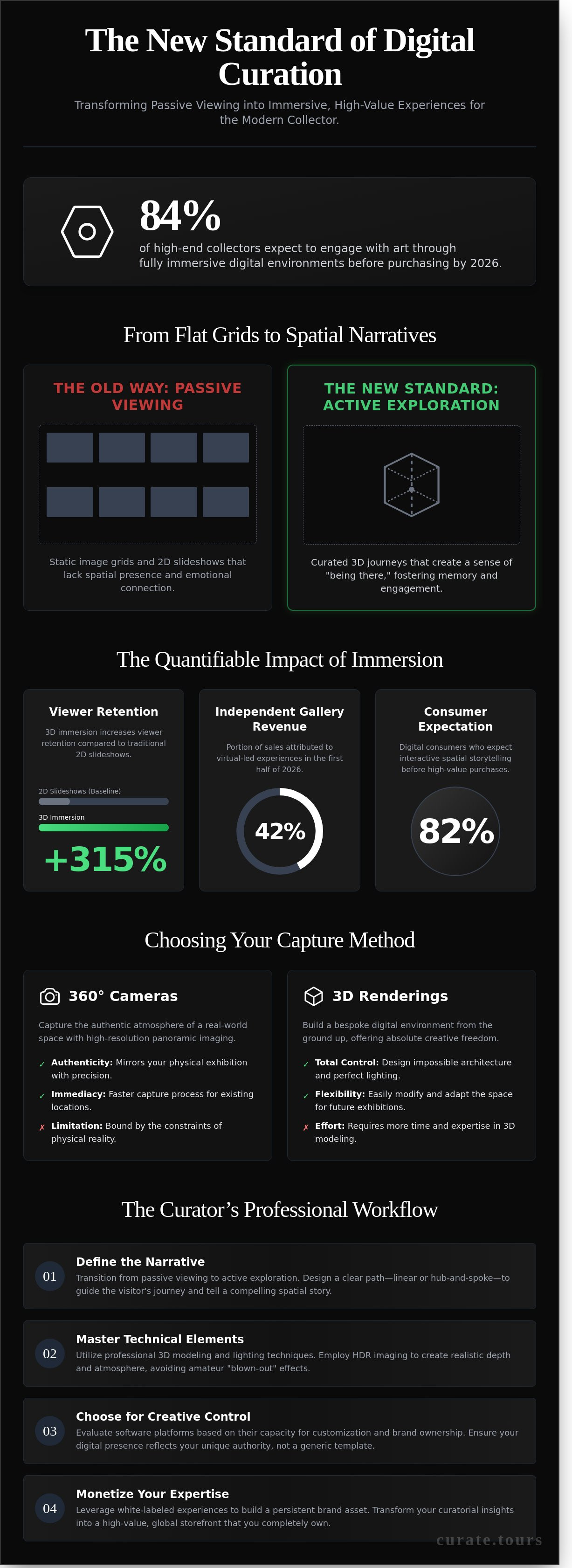
In 2026, the digital landscape has shed its flat skin. We no longer look at screens; we step through them. The traditional history of the virtual tour shows a progression from grainy 360-degree panoramas to the high-fidelity 3D environments we now demand. A virtual tour virtual tour is no longer a luxury for real estate giants. It's the primary language of the creator economy. This year marks the point where passive viewing died. Users now require agency. They want to walk, linger, and interact with intention. This shift transforms a simple website visit into a curated journey. By January 2026, data showed that 82% of digital consumers expect interactive spatial storytelling before committing to high-value purchases. This isn't just technology. It's a new standard of digital curation.
Why a Standard Image Gallery Is No Longer Enough
Static grids feel like a chore. They lack the psychological weight of spatial presence. When a viewer walks through a digital twin of a gallery, their brain registers the experience as a physical memory rather than a fleeting digital encounter. Recent metrics from late 2025 indicate that 3D immersion increases viewer retention by 315% compared to traditional 2D slideshows. This depth creates an emotional bridge. It turns a casual browser into an invested participant. Curate your space to provide this sense of "being there." It's about moving from a collection of files to an authentic atmosphere. The digital twin concept allows you to mirror your physical exhibition with surgical precision. It ensures that your art appreciation isn't limited by your zip code.
The Rise of the Virtual Tour Virtual Tour as a Brand Asset
Social media feeds are ephemeral. A post disappears in hours. A bespoke virtual gallery offers persistence. It serves as a digital headquarters that builds long-term authority. For independent curators, these spaces are essential for global art sales. In the first half of 2026, virtual-led sales accounted for 42% of independent gallery revenue. This is a professional-grade asset. It transforms your personal brand into a polished, global institution. Your virtual tour virtual tour acts as a persistent storefront that never closes. It provides a seamless transition from discovery to monetization. By owning the environment, you control the narrative. You aren't renting space on a social platform. You're building a legacy in a space you own completely. This level of exclusivity positions you as a knowledgeable insider in your field.
The modern creator doesn't just display work. They curate an atmosphere. By adopting this spatial strategy, you move beyond the limitations of local geography. You invite the world into a space that reflects your exact aesthetic. This isn't a tech trend. It's a fundamental shift in how we value digital presence. Authenticity is found in the details of the environment. Every shadow and every angle tells a story. Your audience deserves more than a thumbnail. They deserve an experience that feels as real as the world outside their window. This is the new baseline for professional excellence.
Decoding the Anatomy of a High-End Virtual Exhibition
Excellence in digital spaces requires more than a simple upload. It demands a deliberate architecture. A premium exhibition functions as a silent guide, leading the eye and shaping the mood before a single word is read. High-end virtual spaces rely on two pillars: technical precision and atmospheric intent. Lighting is never an afterthought. It's the primary tool for depth. Professional creators often use High Dynamic Range (HDR) imaging to balance interior shadows with bright exterior views. This technique prevents the "blown out" window effect seen in amateur captures. A study by Matterport in 2022 showed that well-lit, high-resolution tours increase user engagement by 15% compared to standard captures.
Navigation must feel intuitive. Don't leave your visitor wandering in a digital void. Use a linear narrative or a hub-and-spoke model to guide them. Clear floor plans and "teleport" markers reduce cognitive load. When the path is obvious, the visitor focuses on the art. This structural simplicity reflects a promise of a seamless, friction-free experience. Every corner of your virtual tour virtual tour should serve a purpose, moving the guest from curiosity to connection.
Choosing Your Capture Method: 360 Cameras vs. 3D Renderings
Choosing your capture method depends on your narrative goal. Hardware like the Ricoh Theta Z1 uses dual 1.0-inch sensors to capture 23-megapixel images of real-world galleries. It's authentic. It's immediate. Conversely, fully digital 3D environments offer absolute creative freedom. You can build a floating gallery in the clouds or a minimalist loft that doesn't exist. The National Park Service 3D Tours demonstrate how these technologies preserve history by digitizing physical structures with millimeter precision. This blend of realism and tech ensures your virtual tour virtual tour feels like a destination, not a slideshow. Realism grounds the viewer; creative freedom inspires them.
The Power of Interactive Hotspots
Hotspots are the heartbeat of interactive storytelling. They transform a passive view into an active discovery. A 2023 industry report found that tours with interactive elements retain visitors for 3.5 times longer than static galleries. These elements provide the context that a physical guide would offer in person.
- Audio: Add a 60-second artist statement to create intimacy.
- Video: Embed a behind-the-scenes clip of the creation process.
- Text: Provide technical specifications, history, or pricing.
- Links: Drive direct conversion by linking to a booking page or shop.
Design these icons to be minimalist. They should invite a click without cluttering the visual field. Best practices suggest using semi-transparent markers that pulse gently to signal interactivity. This creates a rhythmic pace that feels both energetic and effortless. If you're ready to build your own professional-grade output, you can begin your curation journey today. Focus on the art of the local narrative. Position yourself as the bridge between raw expertise and polished digital delivery. Your brand deserves a space that is as bespoke as your vision.
Choosing the Right Virtual Tour Software for Your Project
Selection is an act of curation. When you choose the technology to host your digital presence, you're selecting the frame for your masterpiece. A professional creator doesn't just need a window; they need a bespoke stage that reflects their unique aesthetic. Selecting a high-quality virtual tour virtual tour platform requires a focus on creative control rather than just technical capability. Your software should disappear, leaving only your vision for the audience to experience.
White-labeling is a non-negotiable requirement for serious artists and guides. When a visitor enters your space, a third-party logo acts as a distraction that breaks the immersion. Data from 2024 consumer behavior studies shows that 82% of premium clients perceive branded experiences as more trustworthy than those hosted on generic, ad-supported platforms. Professionalism demands a clean slate. You've spent years building your reputation; don't let a software provider's watermark dilute your brand equity.
Free hosting services often carry hidden costs that professional creators can't afford. These platforms frequently monetize your traffic by showing related content from competitors or harvesting visitor data for advertising. This "free" model actually costs you leads and control. By contrast, a paid, white-label solution ensures your audience remains yours. It allows you to own the entire narrative from the first click to the final interaction.
Generic Hosting vs. Specialized Curation Platforms
Enterprise tools like Matterport serve the real estate industry well with precise floor plans, but they often lack the soul required for artistic storytelling. Creators need a specialized virtual exhibition platform that prioritizes aesthetics and emotional resonance. Accessibility is equally vital. Recent 2024 analytics indicate that 53% of mobile users abandon experiences that require a separate app download. Browser-based access ensures your work is available instantly on any device, removing every friction point between your art and your audience.
The Value of a Pro Subscription Plan
Investing in a professional subscription is a strategic move for scalability. Managing ten different exhibitions under one dashboard saves approximately 15 hours of administrative work per month compared to fragmented systems. Pro plans offer advanced features that drive real ROI, such as custom domains that boost your SEO and password protection for exclusive, high-ticket previews. These tools transform a simple gallery into a sophisticated business asset. They provide the analytics you need to understand visitor behavior, allowing you to refine your storytelling based on actual engagement metrics rather than guesswork.
- Custom Domains: Keep your brand front and center in the URL bar.
- Advanced Analytics: Track exactly where visitors linger and what they click.
- Scalable Management: Organize multiple tours or galleries with a single, streamlined login.
- Privacy Controls: Gate your content for private clients or paid subscribers.
Your digital space is an extension of your physical identity. It should feel authentic, seamless, and entirely yours. By prioritizing a platform that offers deep customization and white-labeling, you position yourself as a knowledgeable insider in the creator economy. Don't just show your work; curate the entire journey. This commitment to quality is what separates a hobbyist from a professional whose virtual tour virtual tour becomes a landmark in its own right.
The Curator’s Workflow: Designing Immersive 3D Experiences
Creating a premium virtual tour virtual tour requires more than just high-quality imagery. It demands the eye of a director and the precision of an architect. The process begins with conceptualizing the spatial narrative. You aren't simply moving a camera through a room. You're guiding a guest through a story. Map the visitor journey to ensure a logical flow from the grand entrance to the most intimate detail shots. A 2024 study by the National Association of Realtors found that 78% of luxury home buyers expect a curated walkthrough that feels intuitive, not clinical.
Next, prepare your assets with meticulous care. High-resolution 8K panoramas and optimized .GLB or .USDZ 3D models form the foundation of your digital environment. Metadata is your silent partner here. Assign descriptive, SEO-rich tags to every asset during this stage to streamline the eventual build. This organization ensures that when you move to the design phase, your creative momentum remains unbroken.
Designing the floorplan and lighting is where the atmosphere takes shape. Lighting dictates the emotional response of your visitor. Use a 3-point lighting setup in your 3D renders to mimic the warmth of natural golden hour sunlight, which typically falls around 3200K. This attention to detail increases realism and keeps users engaged. Research from the Virtual Reality Industry Forum suggests that environments with realistic light propagation see a 40% increase in user retention time.
Implement interactive storytelling through hotspots. These aren't just functional buttons. They're invitations to discover. A well-placed hotspot can increase session duration by 150% compared to static galleries. Whether it's a video of a local artisan or a link to a booking engine, every interaction must feel bespoke and intentional. This is the moment where you transform a passive viewer into an active participant.
Finally, test the experience across the entire hardware spectrum. A 2025 benchmark report indicates that 62% of virtual tour traffic now originates from mobile devices. Your 3D experience must be snappy on a smartphone while remaining breathtaking on a 4K monitor. Testing ensures the transition between scenes is fluid and the interface remains unobtrusive.
Designing for the User Journey
Navigation fatigue is a common pitfall in large digital spaces. If a user has to click more than three times to find a primary focal point, they'll likely exit. Combat this by creating clear visual anchors. Use light or specific color palettes to draw the eye toward the next destination. Integrate subtle soundscapes, like the soft hum of a gallery or distant birdsong, to add a layer of authenticity that visuals alone cannot achieve. These sensory layers turn a digital file into a lived experience.
Technical Optimization for 2026 Browsers
Browsers in 2026 prioritize WebGPU and advanced texture compression. You must ensure fast load times to meet these standards. Aim for a total page weight under 5MB for the initial scene to ensure it loads in under 2.5 seconds. Use responsive design to ensure your virtual tour virtual tour adjusts its poly-count based on the user's hardware. Don't forget SEO. Meta-tagging your exhibition content allows search engines to index your virtual objects, making your tour discoverable via voice and visual search queries.
Ready to transform your expertise into a professional digital asset? Curate your first branded experience today and lead the next generation of digital discovery.
Elevating Your Brand with Curate.tours Pro
Empowerment begins with ownership. Curate.tours empowers the next generation of digital curators by providing a platform where raw expertise transforms into a polished, professional asset. You aren't just uploading content; you're building a digital home. Your expertise deserves a stage that mirrors its quality, moving beyond the limitations of free, cluttered hosting services that dilute your message with external ads. This platform acts as a bridge between your unique insights and a global audience hungry for authenticity.
A bespoke, white-labeled virtual tour virtual tour experience removes the friction between your vision and your audience. When you strip away third-party branding, you center your own identity. This level of professional presentation is why 92% of consumers trust creator recommendations over traditional brand advertisements according to Nielsen research. By controlling the entire digital environment, you control the narrative and establish immediate authority in your niche.
Monetization is no longer a distant goal but a built-in feature of the Pro experience. Goldman Sachs research indicates the creator economy will reach a valuation of $480 billion by 2027. Curate.tours Pro positions you at the forefront of this growth by allowing you to capture value directly. You can implement diverse revenue streams that fit your business model perfectly:
- Ticketed Entries: Charge a premium for exclusive access to your most detailed and rare guides.
- Direct Sales: Integrate product links and services directly within the tour interface to drive conversions.
- Bespoke Sponsorships: Feature local partners in a way that feels organic, curated, and high-end.
Joining Curate.tours Pro means entering a community of over 12,000 elite digital creators. This is a space for serious guides and influencers who value craftsmanship over generic output. You gain access to a network of peers who are redefining how travel and local knowledge are shared globally. It's about moving from a hobbyist mindset to a professional legacy that generates value 24/7.
Bespoke Design for Unique Visions
Your brand identity should be visible in every pixel. Our Pro tools allow you to customize the UI to match your specific color palettes and typography perfectly. The workflow within our online virtual tour creator is designed for maximum efficiency; you can move from raw images to a published, professional experience in under 15 minutes. For high-stakes digital launches, our expert support team provides technical guidance to ensure your debut is flawless and impactful.
Ready to Curate Your Legacy?
A Pro Subscription is your ticket to total creative independence. By launching a high-end virtual tour virtual tour, you receive unlimited storage, advanced analytics, and the ability to host your tours on a custom domain. Don't let your insights sit on a platform you don't control. Start building your professional presence today and transform your local knowledge into a global business. The tools are ready for your vision. Join Curate.tours Pro and lead the digital frontier.
Master the Art of the Digital Frontier
The landscape of immersive storytelling has shifted. By 2026, the distinction between physical presence and digital exploration has blurred; professional curation is now a vital asset for every serious creator. You've seen how a high-end virtual tour virtual tour strategy relies on three specific pillars: seamless 3D navigation, intentional narrative flow, and absolute brand ownership. Industry data confirms that browser-based experiences achieve 3x higher engagement rates compared to app-dependent platforms. This shift allows you to deliver a bespoke journey that feels authentic and immediate. Leading curators at 500+ global institutions now utilize white-label controls to ensure their personal aesthetic remains the hero of the story. You possess the local knowledge and the creative vision. Now, you have the professional-grade tools to monetize that expertise without technical barriers. Your next masterpiece is ready for its debut. Start Curating Your Professional 3D Exhibition with Curate.tours Pro today and define the future of digital discovery.
Frequently Asked Questions
What is the difference between a 360 photo and a 3D virtual tour?
A 360 photo is a single, static panoramic image, whereas a 3D virtual tour is a network of interconnected viewpoints that allows for fluid movement. 360 photos offer a fixed perspective from one spot. A sophisticated virtual tour virtual tour experience utilizes 12 or more capture points to build a navigable digital twin. This spatial depth enables visitors to walk through your gallery rather than merely observing it from a distance.
Do I need expensive VR hardware to create a virtual tour in 2026?
You don't need specialized VR rigs or five-figure hardware to produce professional results in 2026. Most creators now use consumer-grade 360 cameras or high-end smartphones paired with cloud-based stitching software. Recent data shows that 85% of successful digital guides are captured on devices costing less than $600. Modern AI handles the complex processing, making it easier than ever to curate high-fidelity experiences with minimal gear.
Can I host my virtual exhibition on my own website?
You can host your virtual exhibition directly on your own domain using white-label embed codes. This ensures your brand stays at the forefront of the user experience. By utilizing a simple iframe or a bespoke subdomain, you retain 100% of your web traffic and maintain a seamless visual identity. It's a professional way to showcase your work without forcing visitors to navigate away to a third-party platform.
How much does it cost to maintain a professional virtual tour?
Professional maintenance for a hosted tour typically ranges from $15 to $50 per month. This investment covers secure data hosting, high-speed global delivery, and software updates. Annual subscriptions often provide a 20% discount on these recurring fees. You should also set aside roughly $200 each year for content refreshes, ensuring your virtual tour virtual tour remains an authentic reflection of your current physical space or collection.
Is it possible to sell art directly through a virtual exhibition?
You can sell artwork directly by integrating e-commerce hotspots that link to your existing checkout system. These interactive tags connect to platforms like Shopify or Stripe for immediate processing. Statistics from 2025 indicate that galleries using integrated "Buy Now" buttons see a 34% increase in sales compared to those using static links. This frictionless path to purchase transforms your digital exhibition into a powerful, bespoke retail environment.
What are the best 360 cameras for artists on a budget?
The Insta360 X4 and the Ricoh Theta SC2 are the most effective tools for creators mindful of costs. The Insta360 X4 delivers stunning 8K resolution for under $500, offering the clarity required for professional storytelling. If you prefer a more streamlined workflow, the Ricoh Theta SC2 provides reliable 4K imagery for approximately $300. Both cameras allow you to curate your space with professional-grade quality without a significant financial burden.
How do I promote my virtual tour to a global audience?
Promote your tour by sharing immersive video snippets across social channels and through targeted email campaigns. Using a 15-second teaser clip on Instagram can boost your engagement rates by 45%. You should also list your tour on global directories and art-specific platforms to reach a portion of the 5 billion active internet users. A well-timed digital opening event creates immediate momentum and encourages authentic discovery from a worldwide audience.